A quick map before we wander off trail
- Who they are: what “white-fronted” means, and where they fit among capuchins
- Where they live: canopy life, travel style, and why place matters (hello, Tambopata)
- How they eat: snacks, hunting, and the messy job of finding food every day
- How they think: planning, problem-solving, and the “tool-ish” stuff
- How they get along: group politics, grooming, and communication
- What threatens them: habitat loss, pet trade pressure, and what helps
Okay—now we can talk monkeys.
So, what’s a white-fronted capuchin, really?
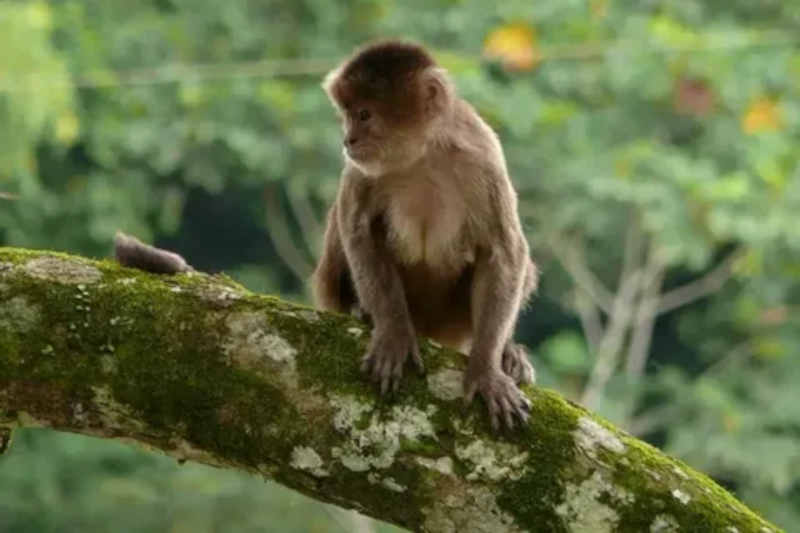
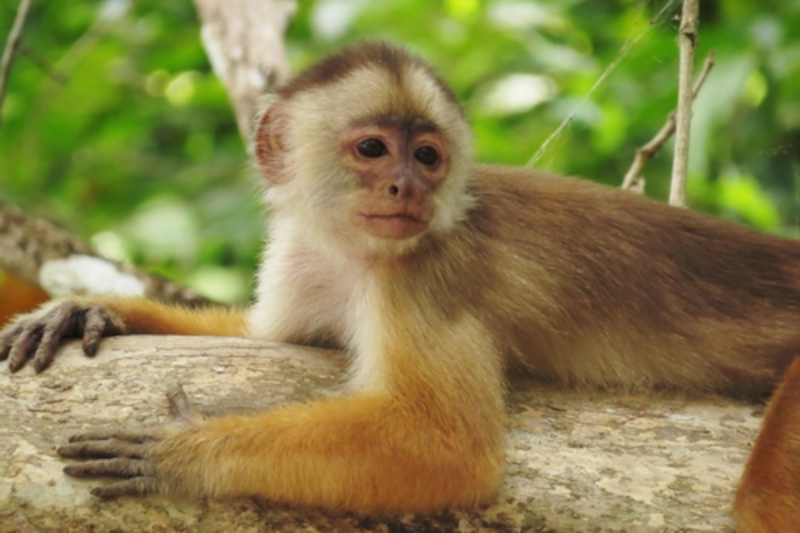
The white-fronted capuchin (Cebus albifrons) is a small New World monkey from the Amazon region. “White-fronted” is literal: there’s a pale patch of fur across the forehead that makes their face look a bit like it’s framed by a soft hood.
If you’ve ever seen a capuchin on screen, you might picture a tough little monkey with a lot of swagger. That vibe isn’t wrong. White-fronted capuchins are quick, curious, and bold—like the coworker who always volunteers for the weird project because they want to see what happens.
They’re also one of the better-known capuchin monkey species, and if you’re collecting capuchin monkey facts, here’s a good one: their brains are large for their body size, and they act like it. They watch. They learn. They copy. And then they try something new.
Where they spend their time (spoiler: it’s mostly up)
White-fronted capuchins live across parts of Colombia, Ecuador, Peru, Bolivia, and Brazil, in forests that can look similar on a map but feel wildly different on the ground. Some areas are dense and shady. Others are broken into patches by rivers, farms, or roads. And that changes everything about daily life—routes, risk, even mood.
Most of the action happens in the mid-canopy and understory. They move with a mix of leaps, careful climbs, and quick scrambles. Their tail isn’t a full-on gripping hook like a spider monkey’s, but it’s a steadying handrail—wrap, balance, reach, repeat.
And here’s a small tangent that matters: rainforest “layers” aren’t only a biology diagram. They’re also a logistics problem. The canopy is a highway. The understory is a slow lane. The forest floor is where trouble waits—big cats, snakes, and human activity. So the troop tends to manage “vertical space” like a risk team manages exposure: stay mobile, stay alert, don’t linger where the odds look bad.
Tambopata: a place where behavior gets extra visible
If you’ve heard the name Tambopata, it’s probably because the Peruvian Amazon there is famous for wildlife. The cool thing (and sometimes frustrating thing) about watching capuchins in a place like Tambopata is that you see the whole loop: feeding trees, travel corridors, rival groups, and the sudden hush when a raptor shadows the canopy. It’s not a zoo exhibit. It’s a living schedule that keeps changing.
What’s on the menu? More than fruit, and less “cute” than you’d think

White-fronted capuchins are omnivores. Fruit is the main fuel—especially figs and other soft, sugary picks—but they don’t live on fruit alone. They also work for protein: insects, spiders, grubs, and sometimes small vertebrates like frogs or lizards.
That mix shapes their whole day. Fruit trees are like shared calendars: everyone wants the same meeting slot. Insect hunting is more like task work—constant, hands-on, a little chaotic. If a troop hits a good patch of beetle larvae under loose bark, you’ll see a burst of energy that looks almost like excitement. Are they “happy”? That’s a loaded word. But they sure look satisfied.
Also, they’re not neat eaters. You’ll hear them before you see them: dropped leaves, cracked shells, half-chewed fruit thumping down like tiny green hail.
Smart, but not in a “robot brain” way
Capuchins have a reputation for being clever, and it’s earned. White-fronted capuchins aren’t the most famous for heavy tool behavior (their tufted cousins get more headlines), but they still solve problems in ways that feel… familiar. Like they’re running quick experiments.
Researchers have seen capuchins:
- bang hard-shelled prey (like snails) against wood to break it open
- peel curled leaves to check for hidden insects
- use leaves to scoop water from tree holes after rain
That last one always gets me. It’s such a small move, and such a big clue. It says they can treat a leaf as a “thing” with a job. Not a fancy job—more like a paper cup at a picnic—but still, it’s a role. And once you notice that, you start seeing “roles” everywhere in their behavior: lookout, peacemaker, troublemaker, babysitter.
They also carry a mental map of food. Fruit trees don’t produce on demand, and the forest doesn’t hand out alerts. So a troop has to remember what’s ripening where, and when. If you’ve ever managed a complex project with moving deadlines, you already get the concept—except their deadlines are edible.
Group life: a little family, a little office politics
White-fronted capuchins usually live in troops that can range from roughly a dozen individuals to a few dozen. There’s often a dominant male and a dominant female, but “dominant” doesn’t always mean “loud.” Sometimes it’s the monkey who knows when to push, when to wait, and when to let someone else take the heat.
The group has to do a lot at once: forage, stay safe, keep infants close, manage conflicts, and avoid rival troops. That’s a lot of stakeholder management for an animal that weighs a few pounds. And yet—somehow—it works.
Grooming isn’t fluff; it’s strategy
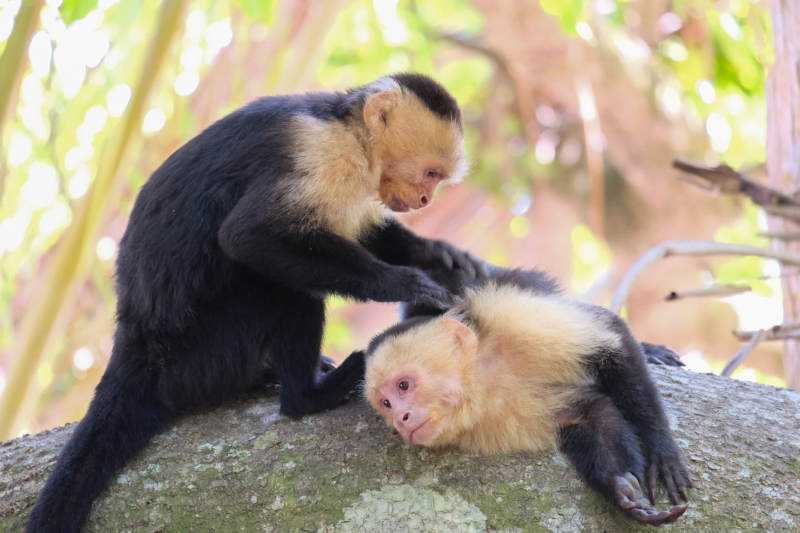
Grooming looks gentle, and it is. But it’s also social glue. Removing ticks and dirt helps, sure. The bigger story is that grooming calms nerves, repairs relationships, and builds alliances. A monkey that grooms well—and grooms the right individuals—can gain support later. It’s not cynical. It’s social reality.
Here’s the mild contradiction: grooming can reduce tension, and it can also stir it up. If one monkey grooms a high-status partner and ignores another, that “snub” can trigger a spat. Social life is soothing… until it isn’t.
Communication: calls, faces, and the art of “don’t panic”
In thick forest, you can’t always see your troop mates. So sound matters. White-fronted capuchins use a mix of chirps, trills, barks, and screams. Some are contact calls—basically “I’m here.” Others are alarms. And some are pure emotion, the way humans blurt “Hey!” when surprised.
They also communicate with posture and facial cues: a stare, a sudden stiffening, a quick head turn. If you’re watching closely, you’ll notice how fast the mood can shift. One second it’s casual foraging. The next it’s silence and stillness. Why? Maybe a hawk. Maybe a snake. Maybe a rival troop nearby. The point is: their communication keeps the group moving as one unit, even when nobody has the whole picture.
Growing up capuchin: babies, learning, and a lot of patience
Young capuchins learn by shadowing adults. They watch hands. They watch timing. They try things, fail, and try again. It’s messy, like any apprenticeship. And yes, they play—chasing, wrestling, swinging too far and scrambling back with that “I meant to do that” energy.
In the wild, life is usually shorter than in captivity. A white-fronted capuchin might live into its late teens or twenties if conditions are good and threats are low. Captive lifespans can be much longer, but that comparison can be misleading. Wild life is harder, but it’s also rich with choice: where to go, who to follow, what to eat, when to rest. Trade-offs everywhere.
Threats: “least concern” doesn’t mean “no concern”
On paper, white-fronted capuchins are often listed as a species of “Least Concern” because they live across a wide range. But a wide range can hide local trouble. When forests are cut into smaller patches, troops may lose safe travel routes and key feeding trees. And when a canopy highway gets turned into a gap, a gap can become a barrier.
There’s also pressure from hunting and illegal capture for the pet trade. Capuchins are charismatic, and that can be a curse. People want them close. But capuchins aren’t domestic animals. They’re smart, strong-willed, and socially complex. Taking one out of a troop doesn’t only harm the individual; it can ripple through the group.
What helps? Protected habitat. Strong local enforcement. And tourism done with care—keeping distance, limiting baiting, supporting guides and lodges that respect wildlife. It’s not perfect. Nothing is. But it can shift incentives in a good direction.
Want to spot them in the wild? Here’s the practical, real-life version
If you’re visiting places like Tambopata, you can improve your odds without turning the forest into a checklist.
- Go early: morning hours are lively. Midday can feel like the jungle hit “mute.”
- Listen for chaos: falling fruit bits and quick calls often give them away.
- Look for movement, not faces: a tail flick or branch sway is the first clue.
- Bring decent binoculars: something like Nikon Monarch or Vortex Diamondback (8×42 is a comfy choice) makes a huge difference.
- Work with a local guide: they know fruiting trees, troop paths, and when to slow down.
And a small note from the “professional habits” department: keep a simple field log. Time, weather, location, what you heard before you saw. It sounds nerdy, but it’s fun—and it trains your attention fast.
Wrapping it up (without making it too neat)
White-fronted capuchins are agile, social, and sharp. They’re also, in a way, relatable: always moving, always negotiating, always looking for the next good resource while keeping one eye on risk. Watching them can feel like watching a tiny team run a highstakes day—except their deliverables are figs, safety, and staying together.
If you ever find yourself under a canopy, hearing a soft scatter of leaves and a quick burst of calls, stop for a second. Look up. There’s a good chance you’ll see that pale forehead flash through the green—and you’ll realize the forest has been busy the whole time. Were you expecting it to be that lively?

