Among the many curassow species, the Razor-billed Curassow (Mitu tuberosum) stands out as a quintessential Amazonian forest bird: large, dark, crestless, and often encountered as a quiet presence on shaded trails. Anyone wondering what makes a curassow bird so compelling to birders should start here.
Focusing on the Razor-billed Curassow, while placing it in the context of curassows and related birds, helps clarify how these big forest frugivores live, why they matter, and why protected areas such as Tambopata National Reserve are so important.
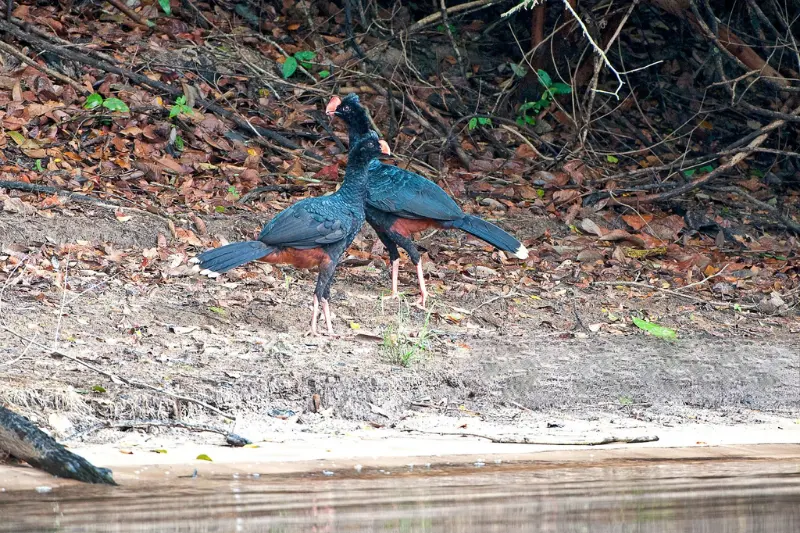
What is a Razor-billed Curassow?
The Razor-billed Curassow is a large member of the Cracidae family, the same group that includes guans and chachalacas. Like other curassows, it adapts well to life in tropical forests, spending much of its time walking and foraging on the ground while also roosting and moving through lower forest levels. Its overall look reads sleek and dark, with a heavy body and a prominent bill profile that gives the species its common name.
Compared with some more ornamented curassow species, the Razor-billed Curassow tends to appear cleaner and more understated. That simplicity can make its posture, movement, and bill shape especially useful for identification in the field, alongside other ground-dwelling species covered in Top Animals You’ll Find in the Tambopata Amazon Rainforest.
Field marks and identification
In most encounters, a combination of size, behavior, and head-and-bill shape identifies the Razor-billed Curassow. The bird is large and long-bodied, usually seen walking deliberately, pausing to scan, or slipping away with surprising speed when disturbed.
Key field impressions include:
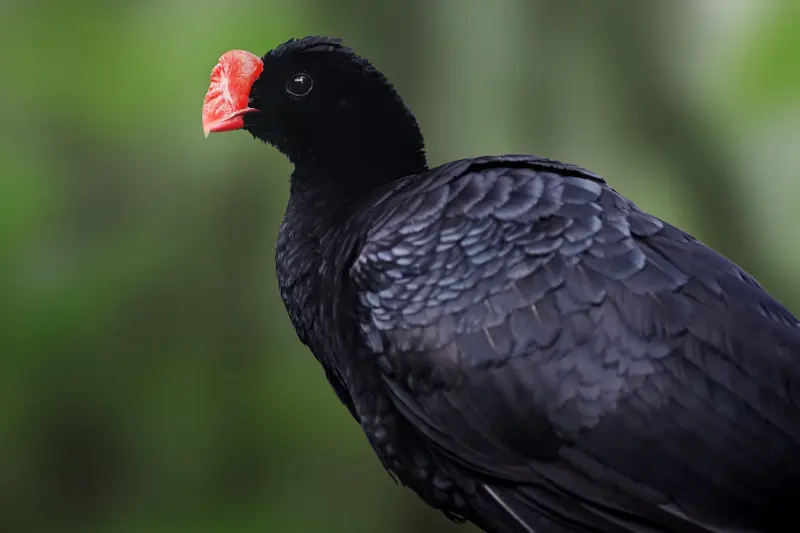
- Overall dark plumage: A glossy, mostly dark appearance that can show subtle sheen in good light.
- Heavy, distinctive bill profile: A strong-looking bill shape that reads as bold even at a distance.
- Ground-oriented behavior: Often on trails, along forest edges, or beneath fruiting trees, rather than high in the canopy.
Because lighting in rainforest understory can be challenging, watching the bird’s outline and movement patterns often helps more than focusing on fine color details. Range and habitat context also matter: narrowing down what curassow species are expected in a given area is often the fastest way to confirm an ID.
Where it lives: Amazonian forests and protected areas
The Razor-billed Curassow is an Amazonian species associated with lowland tropical rainforest, typically in large, intact forest landscapes. It may use a mix of terra firme forest and other wooded habitats, especially where fruit resources stay reliable, a relationship shaped in part by the vegetation described in A Guide to the Incredible Plant Species of Tambopata Rainforest. Like many large forest birds, it generally does best where enough continuous habitat exists to support feeding, nesting, and seasonal movements.
Protected areas play an outsized role for species like this. In Peru’s southern Amazon, Tambopata National Reserve is frequently highlighted for its biodiversity, and Peru’s protected-areas authority notes the presence of the Razor-billed Curassow among its notable birdlife.
Diet and ecological role
Like many curassows and related birds, the Razor-billed Curassow stays strongly tied to forest fruit. It feeds on fallen fruit and other plant material, and it may also take additional items opportunistically. This frugivorous lifestyle is one reason curassows often come up as contributors to forest regeneration: by consuming fruit and moving through the landscape, they help disperse seeds away from parent trees.
In practical terms, a quiet curassow bird on the forest floor is not just an interesting sighting. It can be part of the mechanism that helps keep tropical forests diverse and resilient. Conservation summaries for cracids often emphasize how vulnerable the family can be when hunting pressure and habitat change overlap.
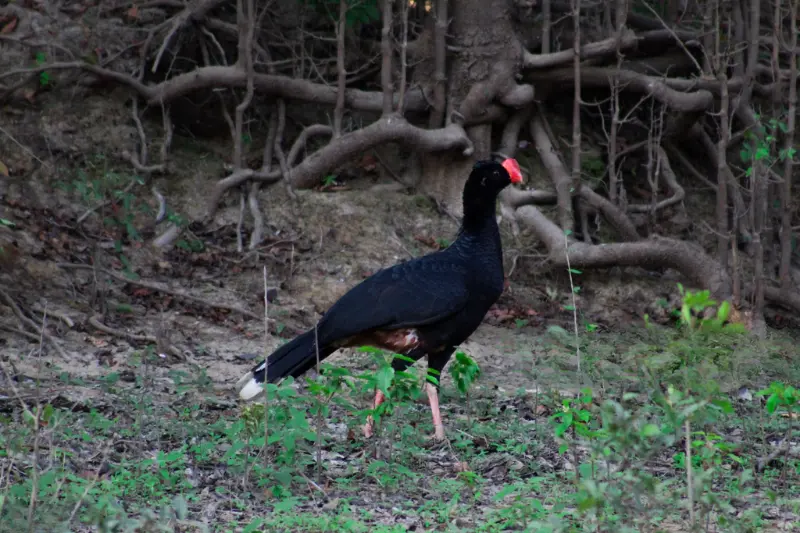
Behavior: shy, observant, and surprisingly fast
Razor-billed Curassows can be cautious around people. Some individuals freeze and rely on camouflage and stillness; others slip into dense vegetation or move quickly away along a trail. Even though they are large, they can vanish in seconds in thick understory, which is part of why researchers increasingly rely on Camera Trapping in Tambopata National Reserve to document ground-level species that are easy to miss during a guided walk.
For anyone trying to see one well, slowing down and watching often works best:
- Fruiting trees: Birds may return repeatedly to productive patches.
- Quiet trail sections: Especially where human traffic is lower.
- Early morning and late afternoon: When forest activity can be easier to detect.
Listening matters as much as looking. Many cracids vocalize in ways that carry through dense vegetation, and sound can be the first clue that a large bird is nearby.
Seeing Razor-billed Curassows in Tambopata National Reserve
Tambopata is one of the best-known places for visitors to experience Amazonian ecology at close range. For birders, a Razor-billed Curassow sighting can feel like a marker of forest health, because large ground birds are often among the first to disappear where forests become fragmented or hunting increases. Timing a visit well also helps, and reviewing Best Times to Visit Tambopata can improve the odds of a productive walk.
However, getting a good look usually depends less on luck than on method. Moving quietly, keeping the group compact, and giving the bird space often results in longer, calmer views. Visitor guidance for Tambopata emphasizes avoiding disturbance to wildlife, a principle that is especially relevant for shy forest birds.
How it fits among curassows and related birds
Understanding the Razor-billed Curassow gets easier when placed among curassows and related birds. Guans are often slimmer and more arboreal; chachalacas are typically smaller and more vocal; and many curassows are heavier, more terrestrial, and more sensitive to disturbance. The Razor-billed Curassow aligns strongly with that curassow pattern: big-bodied, forest-dependent, and frequently encountered at ground level.
In regions where multiple curassow species overlap, comparing overall silhouette and head shape, along with habitat and location, helps a lot. A reliable field guide and a local guide’s experience can prove invaluable for sorting out similar dark cracids under rainforest lighting, much like the identification challenges discussed in Rare Animals of the Amazon Tambopata Wildlife Guide.
Conservation: what threatens the species?
Even when a species is still encountered in good numbers locally, large ground birds face persistent pressures. Habitat loss reduces the size and connectivity of forests, and hunting can have outsized effects because large birds reproduce slowly compared with smaller species. For the Razor-billed Curassow, long-term stability depends on intact habitat, effective protection, and community-focused approaches that reduce unsustainable harvest.
For visitors, the most direct contribution comes from supporting well-managed protected areas and responsible ecotourism, following local rules, and treating sightings as opportunities to observe natural behavior rather than to pursue a close approach. Preparing properly also matters, and What to Pack for Tambopata covers the gear that makes long, patient forest walks more comfortable.
Key takeaways
- The Razor-billed Curassow is an Amazonian curassow bird and a strong representative of curassows and related birds.
- It is typically ground-oriented, often found along quiet forest trails and beneath fruiting trees.
- Its fruit-based diet links it to seed movement and forest regeneration.
- Tambopata National Reserve is an important place to experience Amazonian habitats where this species can occur.
- Protection from habitat loss and hunting is central to the future of many curassow species.
Focusing on the Razor-billed Curassow gives a clear, species-level view of why curassows matter: they are not just impressive birds, but living indicators of intact, functioning tropical forests, part of the same ecosystem explored after dark in Night Wildlife in the Amazon of Tambopata and shaped by the seasonal patterns described in Amazonian Rain, River, and Forest: Climate of Tambopata.

