The atmosphere of the Madre de Dios territory is full of the aroma of damp soil and vibrates with the prehistoric voice of howler monkeys. Where most visitors are picturing the Amazon as a homogenous and inexhaustible green forest structure, Tambopata National Reserve is the so-called Biological Capital of Peru, where the figures of the registered bird and butterfly species are the highest in the world. This remarkable corner of the rainforest offers more than dense vegetation–it provides a front-row seat to one of the most complex ecosystems on Earth and a chance to encounter some of the rare animals of the Amazon that thrive deep within its forests.
Understanding this landscape requires recognizing that not every jungle forms in the same way. Local guides distinguish between secondary rainforest, which regrows after disturbance, and primary rainforest, an ancient forest with a towering canopy where uncommon creatures often hide. These rich old-growth corridors provide the best chance to find endemic species—animals that exist nowhere else in the world—thriving in their specific ecological niches.
To find these elusive animals, it is necessary to draw the difference between a biologically rare animal and one that is difficult to spot. Many species featured in this Rare Animals of the Amazon: Tambopata Wildlife Guide are masters of camouflage or strictly nocturnal, requiring patience and context to locate. When you realize how amazing biodiversity is in Tambopata and how these rare animals work well, you no longer remain a spectator but become an educated follower who is willing to see and feel the unknown beauty of the rainforest.
Tracking the Ghost of the Jungle: How to Spot a Jaguar on the Tambopata River Banks
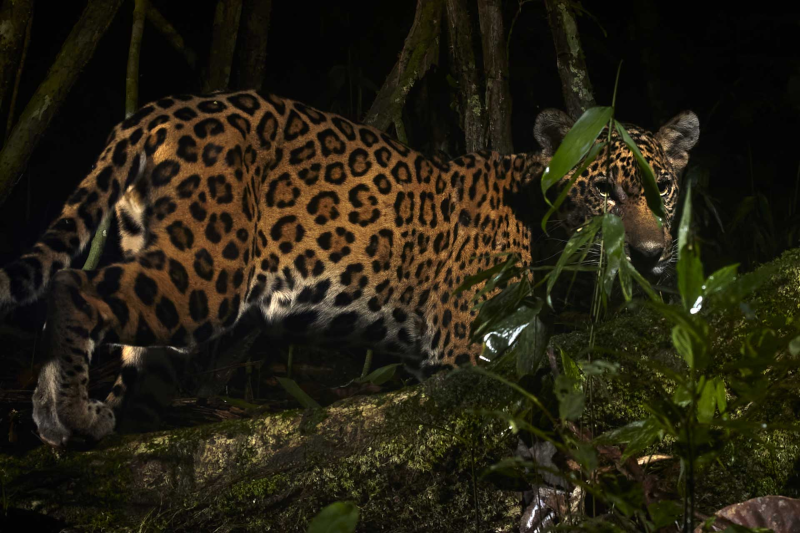
The majority of tourists expect to come across big cats lurking in the thick bushes but the trick to the location of the jaguars in Peru is to look at muddy river banks of the Tambopata River. These big cats are great hunters and make the river their superhighway unlike the other felines who abhor water.
Jaguars practice as the apex predator which is the top predator of the food chain that makes them likely to behave in a certain way. Due to the lack of natural predators, they are too sure of finding large prey in open beaches such as capybaras and caimans. In order to view jaguars in the wild, you should direct them in the hours known as the golden hour which are the dawning and the setting sun. It is at this time that the heat has broken in the day and these great cats start out of the shades to drink or to enjoy the dying light.
When you finally spot the distinctive gold-and-black rosette pattern against the clay, you must instantly suppress any reaction. To obtain the shot, keep the animal relaxed and in order to achieve this, the following is the ethical check list to follow:
- Cut the Engine: Ask your guide to drift silently with the current rather than motoring closer.
- Lower Your Profile: Crouch down in the boat; a standing human silhouette is perceived as a threat.
- Whisper Only: Sound carries effortlessly over water, and a loud voice will send the cat back into the jungle instantly.
Meeting the ‘River Wolves’: Why Giant Otters Rule the Oxbow Lakes of Sandoval
If the jaguar is the quiet murderer of the river-shores, the Giant River Otter is the noisy tenement-house which will not tone him down. Although these animals used to graze across the whole Amazon basin, they formerly constitute one of the largest rare animals of the Tambopata Lakes where they seek refuge in oxbow lakes, such as Lake Sandoval.
Locals often call these animals lobos de río (river wolves) because of their fierce, pack-like behavior. Unlike the solitary otters of North America, this species hunts in coordinated family groups, working together with remarkable precision. The social connections are so high that a group can effectively harass and send away a lot larger predators and take control of the murky water which are at the same time good habitat of black caimans in Sandoval Lake.
To the fortunate traveller, it is only necessary to look deeper than their whiskers, on their necks, to tell whether they are one or another of the wolves. All of these otters have distinguishing cream-colored patches on their throats which are a bit like a human-fingerprint, so that these patterns enable researchers and particularly careful guides to trace the stages of duct and life history of specific creatures over decades.
Nature’s Pharmacy: The Science and Spectacle of the Chuncho Clay Licks
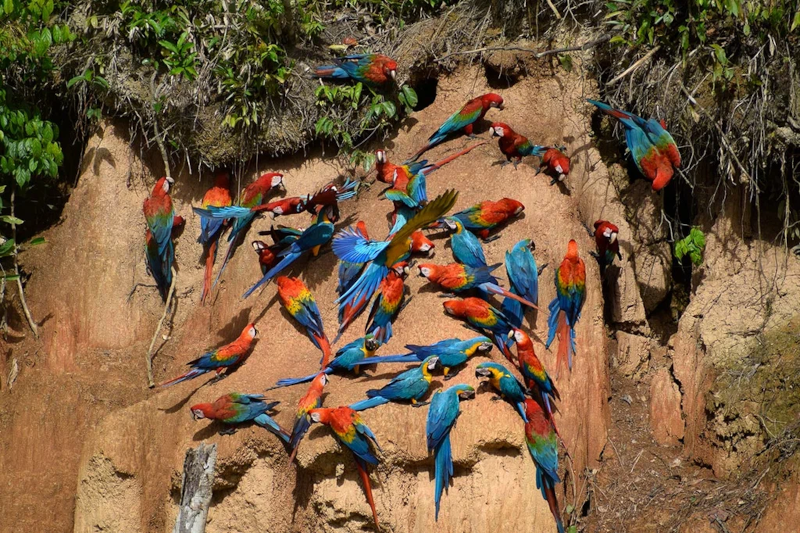
While the river provides isolation for the otters, the steep banks of the Tambopata River serve as an essential communal resource known as a collpa, or clay lick. At first, it may seem paradoxical that the most colorful animals of Tambopata wildlife feed on dull mud. However, scientists call this behavior geophagy, and it plays an important medicinal role.
Macaws often eat seeds and unripe fruits that contain natural toxins or lack sufficient sodium. The clay lick acts like a giant open-air pharmacy: minerals in the soil neutralize dietary toxins and provide essential salts. As a result, hundreds of birds gather at places like the Chuncho Clay Lick, creating a spectacular burst of color and activity.
Identifying the Macaws at the Clay Lick
In the screeching flock, there may be too many species to differentiate as the first-time visitor. The only way to interpret the kaleidoscope is to pay attention to the wing patterns of the three large parrots: the big three:
- Scarlet Macaw: These have a yellow band running through the wing feathers at the top, and separate the red body of the bird, and the blue tops.
- Red and Green Macaw: These are the same as the Scarlet, but are bigger, darker in hue, and have a green band upon the wings, in place of the yellow band.
- Blue-and-Yellow Macaw: They cannot be confused, they have sporty turquoise backs and golden chests, and they store in pairs that can never be separated.
Everything about these Amazon rainforest birdwatching hotspots is timing. The spectacle follows a strict time line, typically at the time when air is cool and thermal currents are fine after a sunrise. By mid morning the heat has increased and the birds scatter and forage in the deep undergrowth. As soon as the sound of the macaws ceases, the forest then enters a period of silence and this is the sign that you are now into the world of a predator that does not require a pack to claim dominance.
The Silent Hunter: How to Spot a Harpy Eagle in the Primary Canopy
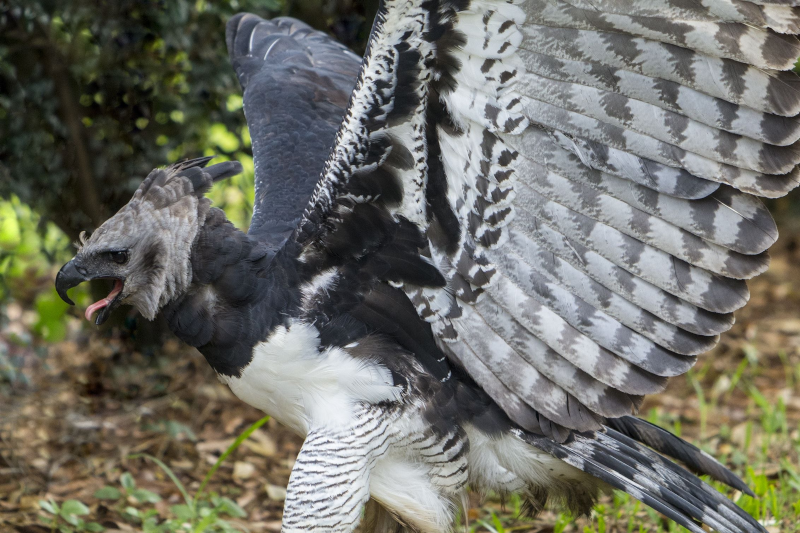
That heavy silence often signals the presence of the Harpy Eagle, the strongest avian predator of the Amazon, they are often estimated by the severe silence. Harpies occupy the main layer of the forest, unlike the Macaws which busy their time searching in the central leaf line, by massive trees, such as the Ironwood which thrust their way through the forest roof like skyscrapers.
Spotting one of these endangered species in Tambopata National Reserve is difficult due to simple ecology. Being the apex predator, one pair of apexes needs about 20-30 square miles of territory, which will provide enough monkeys and sloths to support them. It is only auditory oftentimes that you are the better judge; hear a high melancholic whistle, which seems kinder than a bird with such gigantic Taxation should have.
The main characteristic of a successful sighting includes searching at a very long distance the line of super-trees to detect a clear disc-shaped face and a two-crested head. As much as these raptors prevail during the day, they stop their operations as the jungle starts experiencing a twilight. The shadows propelling the light in the air force the eagles to a perch, leaving the stage to a totally different squad of characters which found it safer in the shadows casting of day than in the glaring heat of day.
The Midnight Shift: Encountering Tapirs and Caimans After Dark
When the sun goes down, the Amazon becomes the kingdom of acoustic bewilderment and visual obscurity. In passing through this darkness, you will use the tapetum lucidum, a layer behind the retina that reflects and forms an eye shine called the famous eye shine when a person is using a flashlight. When you look along the water’s edge, you will often see a glow of red eyes—the unmistakable sign of the Black Caiman. While the smaller Spectacled Caiman appears throughout the region, Sandoval Lake provides an ideal habitat where the much larger black caiman still thrives.
Nocturnal Wildlife of the Amazon Rainforest
Deep in the forest, you may also hear the powerful movement of the Lowland Tapir, the largest terrestrial mammal in the Amazon, as it pushes through the dense undergrowth. The giants are the most significant forest gardeners in the jungle and look like a weird cross between a wild boar and an anteater, small animals. They scattered away the seeds that are not close to the parent tree because they pass great amounts of fruit and cover long distances before defecating it. This is critical towards the sustenance of the healthy vegetation on which endemic wildlife of the Madre de Dios region relies.
It takes observation skills and technique to see these creatures. When taking photos of animals at night in Amazon it is advisable to avoid direct exposure of bright spotlights in the eyes of the animals as this will cause a temporary blind effect, but should keep the beam slightly off center or even use a red filter until you are ready to take photos. This dignified attitude does not just prevent the animal un-sightedness but tends to relax it to allow it to see longer. To see is one thing, but to know where to go is more important to these seldom fulfilled encounters.
Planning Your Encounter: Tambopata vs. Manu for High-Impact Wildlife Viewing
The trick lies in choosing between two titans of the wilderness in Peru and usually a trade-off occurs between the time spent travelling and the time spent isolated. Although the Tambopata vs Manu National Park dosage of biodiversity is equal – both have Jaguars, Giant Otters, and Macaws, the logistics between the two are drastically different. The deep end of the Amazon is Manu National Park, and takes a couple of days to get to the untouched areas, but Tambopata provides the plunge, where in hours of landing in Puerto Maldonado you are in the world’s most favored wildlife habitat.
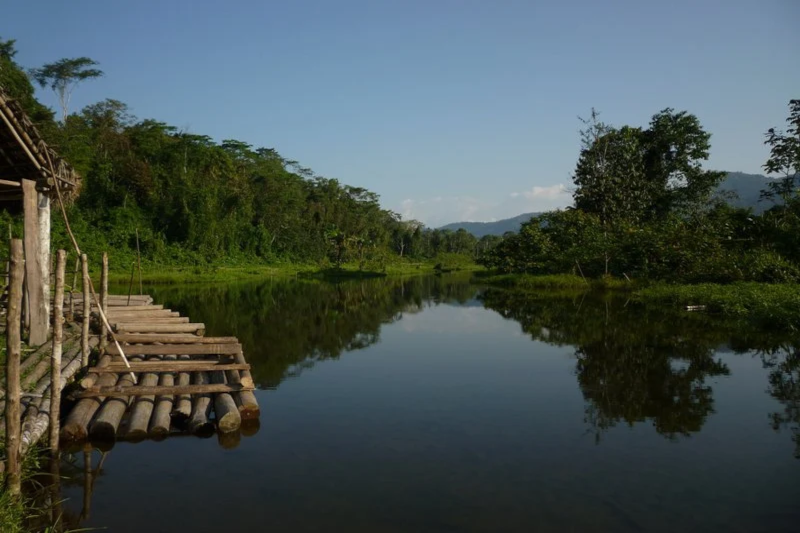
When you choose your destination, proper scheduling of your trip would significantly boost your chance of sightseeing. The Tambopata wildlife tours are best between May and October; this is in the dry season which causes the elusive wildlife in the Amazon to come out of the thick forest so as to drink water at the edge of the river which serves like an eye to the visitor.
Your choice of operator matters just as much as your timing. To make your wildlife experience in Peruvian jungle ethical it is advisable not to visit lodges that claim to work with the animals or feed them with food baits- the characteristics of the so-called greenwashing. Rather, prefer certified eco-lodges that do not allow large groups of people and hire local naturalists so that your tourism money is used effectively to protect the habitat you are visiting.
Becoming a Guardian of the Green: How Your Visit Protects Rare Species
The Tambopata area is a delicate and intertwined network. The acknowledgment of the Peruvian Amazon basin biodiversity is not only about hunting animals down a list but creating an understanding that all Giant Otters and Harpy Eagles need undisturbed habitats to survive. You have risen above an idle observer to a knowledgeable lover who is prepared to see, but not to interfere with nature.
Your presence may serve as a protection over these species. The financial source of wildlife protection is sustainable tourism as it demonstrates that the forest with trees is worth more than the cut forest. To leave the jungle sandal-clean, pack this “No-Trace” check list to prepare your adventure:
- Long-sleeved clothing with minimal weight (the most efficient non-toxic technique of mosquitoes prevention in treks in the Amazon jungle).
- In order to handle sensitive oxbow lakes, the biodegradable soaps are used.
- Single-use plastics to be helped by a reusable water container.
- Field glasses to view wildlife.
Amazon tells secrets to the ones who hear. You will save the clay licks, which are full of macaws, and the river wolves, prowling upon the waters, by walking lightly and working at the conservation of ethics. You are not a visitor anymore: you are one of the partners in keeping one of the wildest places on the planet preserved.


… [Trackback]
[…] Read More here: paradiseyakari.com/rare-animals-amazon-tambopata-wildlife-guide/ […]