The jergón snake is the Peruvian Amazon name commonly used for Bothrops atrox, a highly venomous pit viper also called the common lancehead, fer de lance snake, snake fer de lance, or barba amarilla. In Tambopata Reserve, it is best understood as a ground-dwelling Amazon predator. It can be seen on forest trails, in leaf litter, near water, or around disturbed edges where prey is active. For visitors, the goal is not to get close enough for a perfect identification. The real goal is recognizing the warning signs and giving the animal space.
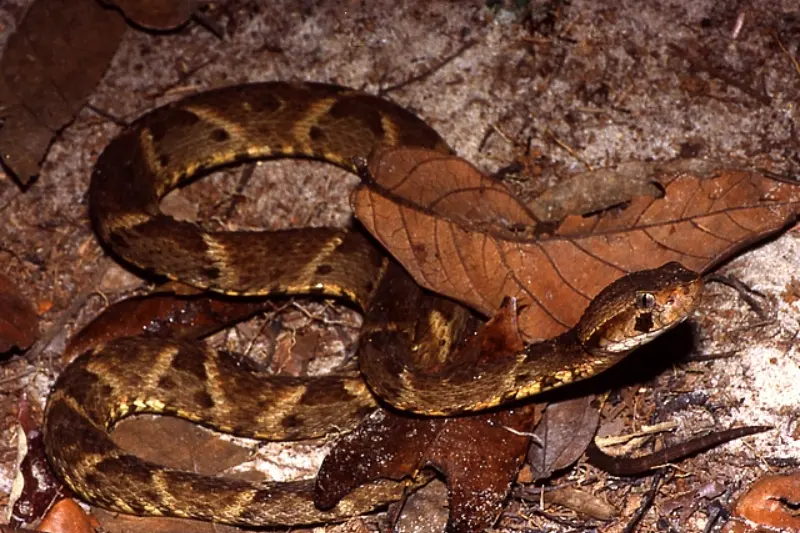
What is the jergón snake?
The jergon snake, Bothrops atrox, is a venomous viper of tropical lowland South America, including eastern Peru and the wider Amazon region. Taxonomy sources list Bothrops atrox in Peru, and Tambopata Reserve sits in Madre de Dios in Peru’s southeastern Amazon, making the habitat context a realistic one for this species.
Like other pit vipers, Bothrops atrox has heat-sensing pits between the eye and nostril. These pits help it locate warm-blooded prey. It is mainly terrestrial and is widely associated with Amazon rainforest habitats, though it may also occur near disturbed forest edges and human settlements.
The name “fer de lance” can be confusing. In some regions, people use it for more than one lancehead species, especially Bothrops asper farther north. In the Peruvian Amazon, however, “jergón” most often points to Bothrops atrox, the Amazonian lancehead. Travelers curious about the seasonal patterns that shape when reptile activity peaks may also want to check Best Times to Visit Tambopata before booking a trip focused on wildlife sightings.
Key features that define Bothrops atrox
A jergón is not identified by one feature alone. Its value as a field ID comes from a combination of head shape, body pattern, posture, and habitat. In Tambopata, look for a snake that blends into brown leaves rather than one that stands out with bright bands.
Defining characteristics include:
- Broad, lance-shaped head: the head is noticeably wider than the neck, giving the classic “lancehead” look.
- Vertical pupils and facial pits: from a safe distance, these are hard to confirm, but they are key pit viper traits.
- Earth-toned camouflage: brown, tan, gray, olive, or yellowish tones help it disappear into leaf litter.
- Dark side markings: many individuals show triangular, hourglass-like, or irregular dark blotches along the body.
- Keeled scales: the body often looks matte or rough rather than glossy.
- Ground-level behavior: adults are most often encountered on or near the forest floor.
Color varies, so relying on “yellow beard” or barba amarilla as a literal rule doesn’t work well. Some animals look warmer and more golden; others appear dull brown or gray. The pattern can also be partly hidden by mud, shadow, wet leaves, or night-light glare. That same camouflage challenge is part of why Camera Trapping in Tambopata National Reserve has become such a valuable tool for researchers documenting ground-level species that are easy to miss with the naked eye.
Where might you spot one in Tambopata Reserve?
Tambopata National Reserve protects rainforest in the department of Madre de Dios, with access commonly connected to Puerto Maldonado and the Tambopata and Madre de Dios river systems. Its humid lowland forest, river margins, trails, lodge clearings, and secondary growth create the kind of Amazon setting where a terrestrial pit viper can hunt and shelter. Much of that dense understory owes its structure to the region’s plant life, covered in more detail in A Guide to the Incredible Plant Species of Tambopata Rainforest.
A jergón is most likely to be noticed when it crosses a path, rests beside a trail, coils near buttress roots, or waits along the edge of vegetation. Night walks are a common time for snake sightings because many forest animals are active after dark, a pattern explored further in Night Wildlife in the Amazon of Tambopata. Daytime encounters can happen too, when a snake is resting under cover or moving after rain.
In or near Tambopata, extra attention pays off in these microhabitats:
- Leaf litter beside narrow forest trails
- Root tangles, fallen logs, and palm debris
- Muddy trail edges after rain
- Riverbank vegetation and low, damp clearings
- Areas around lodges, gardens, or storage spaces where rodents may occur
- Trail junctions where open walking space meets dense vegetation
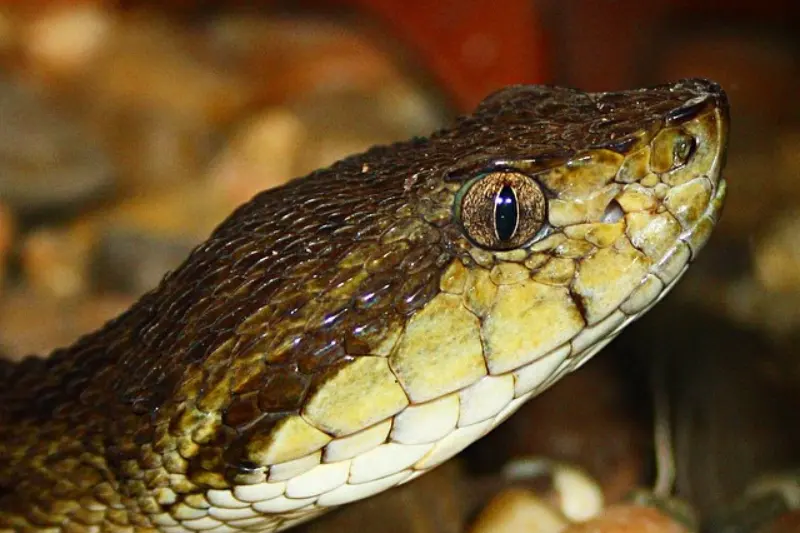
The snake’s camouflage is excellent. Many people “spot” a jergón only after a guide points out the outline: a head angled across the trail, a dark zigzag against leaves, or a coil that looks too smooth and symmetrical to be debris.
How can you tell a jergón from other Tambopata snakes?
A jergón shows itself through a heavy-bodied, earth-colored, ground-oriented pit viper with a broad triangular head and dark lateral blotches. Still, safe identification should be cautious. Tambopata has many snakes, and quick assumptions can be risky.
Common comparisons include:
- Coral snakes: usually slimmer and brightly banded with red, black, yellow, or white rings. Do not handle them; some are venomous, and mimics complicate identification.
- Bushmasters: also venomous pit vipers, but typically much larger, with a more dramatic diamond-like pattern and different overall proportions.
- Boas and anacondas: generally heavier and more muscular, often associated with water, branches, or open resting sites, and lacking the same lancehead profile.
- Harmless forest snakes: many are slender, quicker-moving, or more arboreal, but some brown snakes can superficially resemble young vipers.
A useful rule stays simple: if a snake is brown, patterned, thick-bodied, and coiled on the forest floor, treat it as potentially dangerous. A perfect species ID isn’t necessary to make the right decision, which is to step back, alert your guide, and let the snake leave. For travelers building a broader mental checklist of what else might turn up on the trail, Rare Animals of the Amazon Tambopata Wildlife Guide covers several species that are easy to confuse with one another at a glance.
Behavior and safety around the snake fer de lance
Bothrops atrox is an ambush predator, not an animal seeking contact with people. The danger comes when it is stepped on, cornered, touched, or surprised at close range. Scientific literature identifies Bothrops atrox as a major cause of snakebite in the Amazon, which is why local guides treat it with serious respect.
If you see a suspected jergón in Tambopata:
- Stop walking and keep your feet still.
- Move back slowly without sudden gestures.
- Do not shine lights repeatedly into its face at close range.
- Do not try to move, photograph, or provoke it.
- Tell your guide or lodge staff exactly where it is.
- Keep children and other travelers behind you until the path is clear.
For prevention, closed shoes or boots on trails make a real difference. A flashlight at night, checking the far side of logs before stepping over them, and keeping hands out of leaf litter, holes, and root cavities all matter too. These habits protect both visitors and wildlife, and they line up closely with the broader packing advice found in What to Pack for Tambopata.
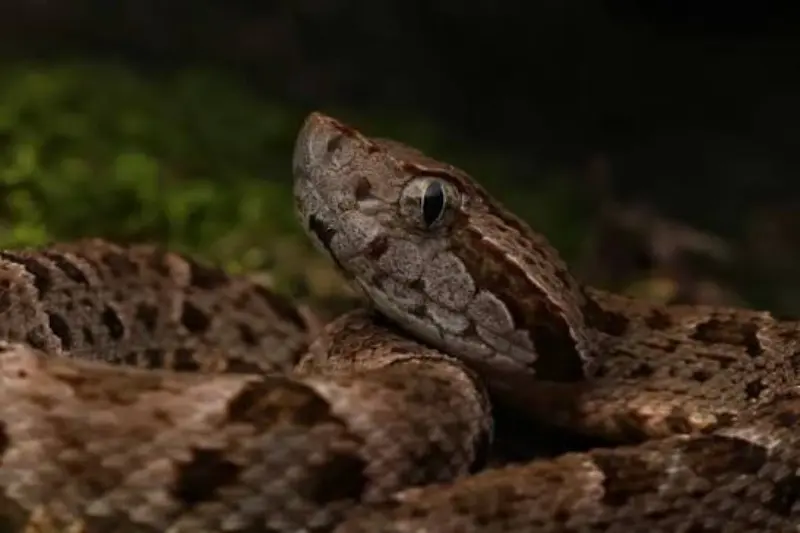
Practical spotting notes for Tambopata visitors
Seeing a fer de lance snake can be memorable, but the best sighting is a respectful one. Staying on marked paths and walking behind trained local guides makes the encounter safer for everyone. Guides know how to manage distance, lighting, and group movement. Tambopata’s wildlife is extraordinary precisely because it is wild; the jergón is part of that living Amazon system, not a photo prop, alongside the wider cast of species featured in Top Animals You’ll Find in the Tambopata Amazon Rainforest.
Weather also shapes how often the jergón and other ground-dwelling species appear, since heavy rain tends to push animals toward drier, higher ground, a pattern discussed in Amazonian Rain, River, and Forest: Climate of Tambopata.
The most important identification takeaway is this: the jergón, or Bothrops atrox, is a camouflaged, venomous Amazon pit viper with a broad lance-shaped head, earth-toned body, dark blotched pattern, and strong association with the forest floor. In Tambopata Reserve, spotting one means slowing down, observing from well back, and respecting the snake’s role as a powerful rainforest predator.

