Walking through the emerald shadows of the rainforest, every rustling leaf hints at something hidden. Beneath the massive roots of a Ceiba tree, perfectly camouflaged against damp forest floor, rests a silent giant. This is the realm of the shushupe snake in Tambopata National Reserve. English-speaking travelers might know it as the Bushmaster. Indigenous guides and local researchers use its traditional name with a different kind of weight behind it.
Stories told around fires paint this creature as a relentless villain, one of the most dangerous amazonian snakes in existence. Field observations from tropical herpetologists tell a different story. The shushupe snake, Lachesis muta, is the world’s longest viper and a vital apex predator keeping the jungle ecosystem balanced. Not a creature seeking conflict with hikers. A master of invisibility that simply prefers not to be noticed. Among the rare animals of the amazon tambopata, the shushupe consistently sits near the top of the list, precisely because encountering one requires both luck and a guide who knows exactly where to look.
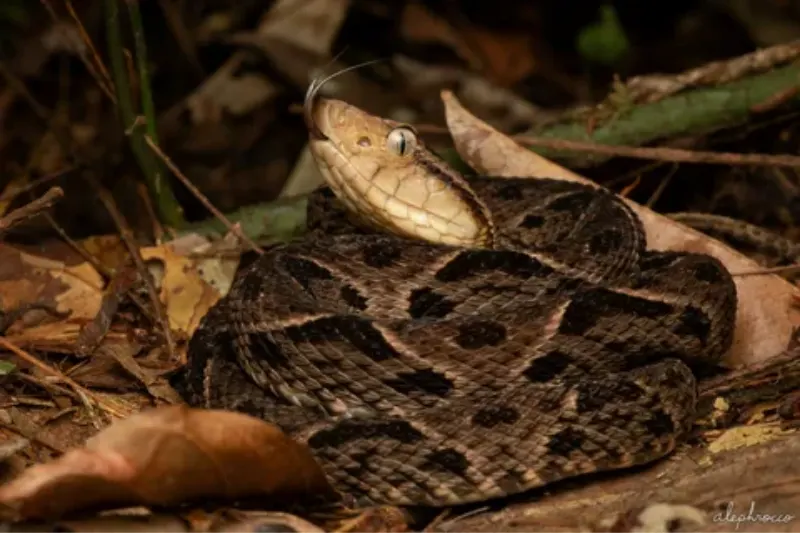
A mature shushupe snake reaches up to twelve feet, roughly the length of a mid-sized car, yet its scales mimic the diamond patterns of sunlight on dead leaves so precisely that spotting one is considered genuinely rare. Local guides consistently remind visitors that encountering this species is a privilege, not a daily threat.
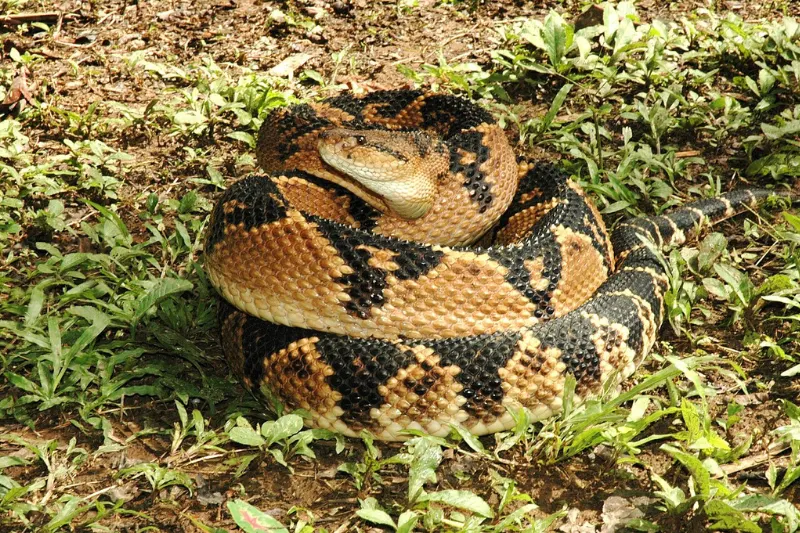
Deciphering the Diamond Pattern: How to Identify a Shushupe in the Wild
Spotting this animal against leaf litter requires searching for specific geometries. The primary visual cue is the diamond and bead pattern, dark diamonds running down a reddish-brown back. A bold black stripe forms a distinct triangle behind each eye, breaking up the head’s outline against the forest floor.
Beyond coloration, the Lachesis muta characteristics reveal a highly specialized hunter. Keeled scales carry a rough ridged texture that diffuses light, matching dead leaves and enhancing the camouflage that makes these amazonian snakes so difficult to locate. Loreal pits between eyes and nostrils function as biological thermal cameras, detecting body heat from passing mammals in complete darkness.
Visual checklist guides use for verification:
- Head: Broad and spear-shaped with the signature dark eye stripe.
- Pattern: Repeating dark diamond shapes along the spine.
- Texture: Rough, distinctly beaded look from ridged scales.
- Tail: Ending in a hardened spine rather than a rattle.
Beyond the Myths: Understanding the Size and Scale of the World’s Longest Viper
Following the trail of diamond scales into the underbrush often reveals something of staggering proportions. While many amazonian snakes are relatively compact, a mature shushupe snake stretches 10 to 12 feet from nose to tail. A serpent the length of a mid-sized car hidden perfectly in leaf litter. That scale secures its title as the largest venomous pit viper in the world, which explains why local rainforest legends built around it aren’t exaggeration.
The physical structure is surprisingly elegant despite the mass. Unlike thick heavy-bodied rattlesnakes, these vipers carry a unique length-to-girth ratio, bodies remaining remarkably slender for their extreme size. Weight distributed evenly across the jungle floor means no heavy crunching of dry foliage. A predator this large moving through dense undergrowth in absolute silence is the result of that specific evolutionary design.
That streamlined anatomy supports a patient terrestrial hunting strategy. Minimal physical footprint means the snake can coil at the base of ancient trees and wait undisturbed for weeks without burning energy it can’t replace.
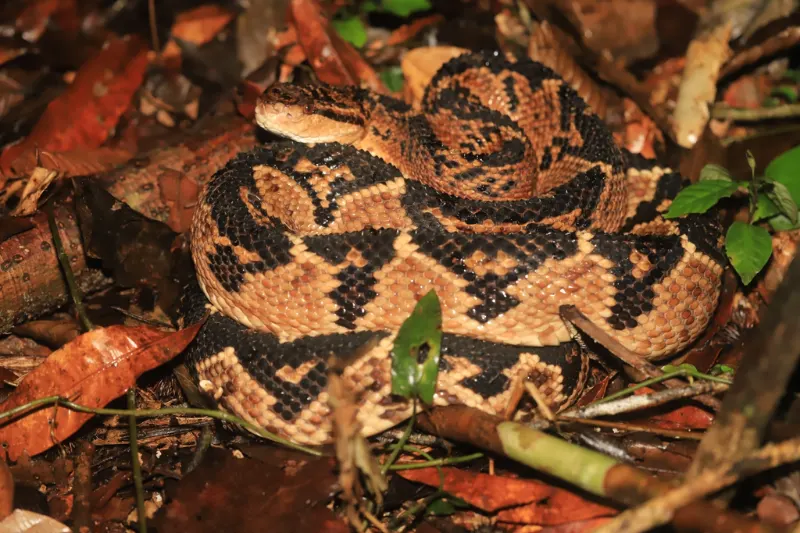
Heat Vision and Vibration: How the Shushupe’s Biology Creates the Ultimate Ambush Predator
When the sun sets in Tambopata National Reserve, the jungle floor goes pitch black. The shushupe snake isn’t blind in those conditions. Specialized facial pits detect body heat radiating from passing rodents, translating temperature differences into a three-dimensional thermal map. That adaptation drives nocturnal behavior, letting the snake pinpoint targets on moonless nights with precision no visual system could match.
Long before a silhouette enters thermal range, the snake feels the forest’s rhythm. Chin resting against the earth, the lower jawbone functions as a sensitive acoustic receiver. Microscopic ground vibrations from scurrying paws travel directly into the inner ear. Feel the footsteps first, lock onto the heat signature second. That dual sensory system anchors a hunting strategy built entirely on certainty rather than speed.
The strike itself is calculated and brief. A rapid bite, immediate withdrawal, then tracking the scent trail to the meal later. Strike and release rather than holding a struggling animal and risking injury. These precise tactics reflect sophisticated instinct rather than mindless aggression, which is why experienced guides describe the shushupe snake with respect rather than fear. The plant species of Tambopata rainforest play a direct role in the shushupe’s survival too, the dense understory vegetation, decaying logs, and root systems of species like Ceiba and Brazil Nut trees provide the specific micro-habitats these vipers depend on for both hunting and nesting.
The Shushupe vs. The Fer-de-Lance: Essential Field Identification Differences
Spotting a large viper on a jungle trail triggers immediate caution, but the next steps depend entirely on the species. The Fer-de-Lance is nervous and reactive, readily striking when startled. The shushupe snake relies on supreme confidence instead, preferring to freeze so people simply walk past without noticing. That behavioral split makes identification significantly easier than markings alone.
Key differences between these amazonian snakes:
- Behavior: Fer-de-Lances act twitchy and reactive. Shushupes remain completely statuesque.
- Tail: Fer-de-Lance tapers normally. Shushupe ends in a hardened spiky spine.
- Pattern: Both share diamond camouflage, but the shushupe snake features uniquely raised rough scales resembling pinecones.
- Size: Fer-de-Lances max around six feet. Shushupes can easily double that length.
Relying on behavior over exact markings is a vital jungle safety principle. A snake holding its ground with quiet immovable weight is likely the forest’s rarest predator. That distinctive spiked tail and calm demeanor transforms potential panic into respectful observation.
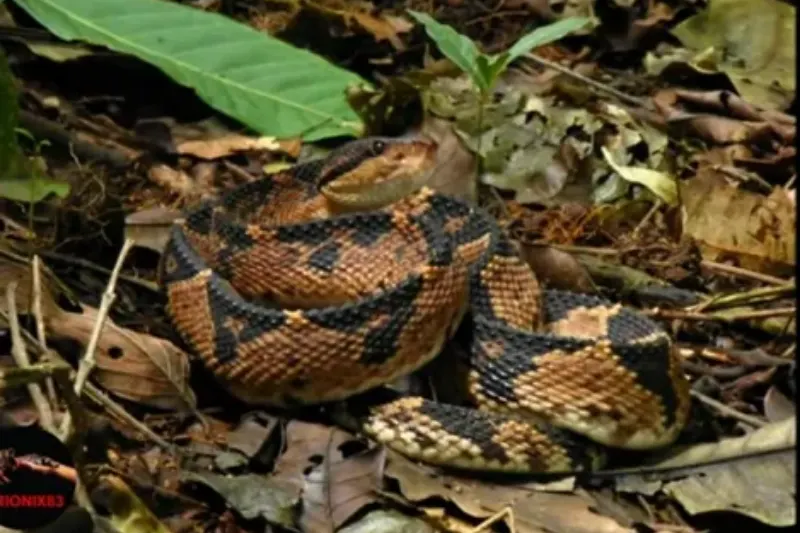
Rare Motherhood in the Undergrowth: The Shushupe’s Unique Egg-Laying Behavior
Most New World vipers give birth to live young. The shushupe snake breaks that pattern by laying eggs, a trait known as oviparity that separates it from its reactive cousins. A female carefully seeks out the dark hollowed-out cavity of a decaying log or burrow to deposit roughly a dozen eggs.
What follows is a display of maternal endurance that defines shushupe nesting behavior. For 60 to 90 days the mother wraps her coils tightly around the clutch to regulate temperature and ward off predators. During that entire three-month incubation window she refuses to leave the nest to hunt or eat, surviving on stored energy alone to ensure the eggs hatch safely.
That extreme dedication creates a window of vulnerability for the species. Anchored to one precise location for an entire season, logging and human encroachment directly threaten these devoted mothers. Protecting them requires identifying the specific ancient undisturbed jungle environments where they build their hidden nurseries.
Where the Giant Rests: Pinpointing Shushupe Habitats in the Madre de Dios Region
Protecting eggs for three months requires ground that won’t wash away. That biological necessity restricts the shushupe snake almost entirely to Terra Firme, the high unflooded zones of the Amazon basin. Unlike seasonally flooded Varzea forests near riverbanks, Terra Firme offers permanent dry shelter these giant vipers require. Moving away from muddy river edges toward older stable terrain in Tambopata National Reserve means entering the true domain of the Bushmaster.
Within dry upland forests, the snake seeks highly specific micro-habitats. Buttress roots of giant Ceiba and Brazil Nut trees create natural wooden alcoves filled with deep decaying leaf litter. Tucked inside, a coiled shushupe snake mimics the diamond patterns of sunlight hitting dead leaves, lying completely motionless while waiting for passing rodents. Ancient upland forest heavily littered with hollow logs and massive roots means staying on the cleared path and watching every step. Top animals you’ll find in the tambopata amazon share this same Terra Firme territory, giant river otters, tapirs, jaguars, and multiple monkey species all moving through the same upland forest zones where the shushupe snake rests hidden during daylight hours.
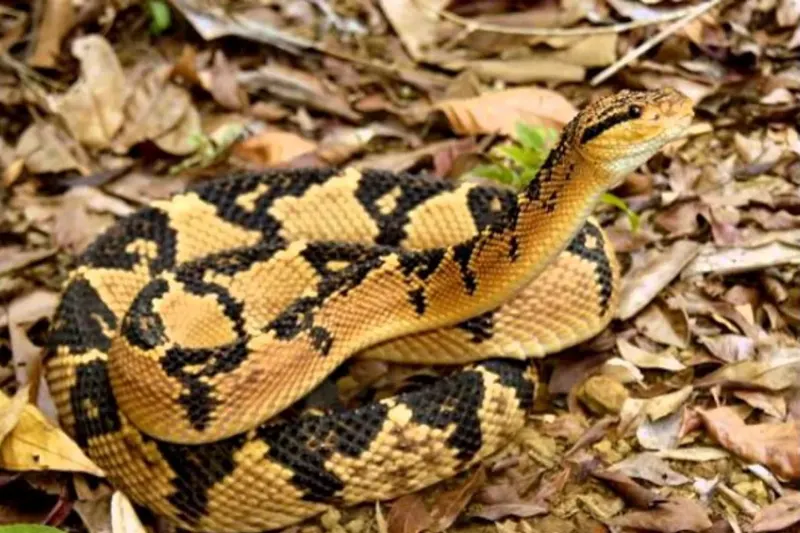
Nocturnal Secrets: Why You (Luckily) Rarely See a Bushmaster on Day Treks
Stepping onto a sunlit trail, crossing paths with a hunting Bushmaster is highly unlikely. Nocturnal behavior restricts daytime activity strictly to resting, meaning roughly 95% of travelers never spot one during a trek. While birds and monkeys dominate the daylight hours, the shushupe snake remains coiled and completely inactive in deep forest floor shadows.
That invisibility runs on extreme metabolic efficiency. The shushupe snake doesn’t waste calories patrolling for meals. Its body operates on such low energy that it can wait in the exact same spot for weeks between feeds, heat-sensing pits ready to detect passing rodents in the pitch black, energy saved for a strike only when a meal is guaranteed.
Hiking for days without seeing this snake simply proves the mastery of their stealth. Perfectly content letting humans walk past while waiting for nightfall. That passive energy-saving nature provides real peace of mind. Safe coexistence in the jungle depends entirely on where feet get placed.
Safe Footsteps in the Amazon: Proactive Habits to Avoid Unwanted Encounters
Because the shushupe snake relies on camouflage over aggression, navigating the forest requires a specific approach. Walking strictly in the middle of the trail creates a natural buffer zone between ankles and the deep leaf litter where these amazonian snakes rest. The Stop, Look, and Listen technique whenever stopping to photograph something, halt forward movement, verify the ground around your feet is clear, then shift attention upward.
A guide to packing for your tambopata adventure should prioritize the five items that directly reduce encounter risk before anything else. Knee-high rubber boots are the single most important piece of equipment on any jungle trail. Long loose pants, a walking stick for probing brush, a high-lumen headlamp for night walks, and insect repellent covering all exposed skin. None of those feel exciting to pack but all of them matter in practice.
Five-step safety protocol guides enforce on every trail:
- Wear 16-inch rubber boots: Most defensive strikes occur below the knee. Tall boots provide a vital physical shield.
- Keep defensive distance: Stay at least two paces behind the guide to allow adequate reaction time.
- Scan the leaves: Constantly look three feet ahead for unnatural diamond patterns in brown foliage.
- Navigate logs carefully: Step onto fallen trees first to visually inspect the blind side before stepping down.
- Use a walking stick: Probe thick brush with a stick rather than a leading foot.
First Aid Reality Check: Saving a Life After a Bushmaster Bite
In the rare event of a shushupe snake strike, immediate actions must focus on calm efficiency. Venom is hemotoxic, attacking blood and tissue rather than the nervous system, which means dramatic Hollywood cures cause massive additional harm rather than helping.
The Do-Not List: No cutting the wound, no sucking out venom, no tourniquets.
The Action List:
- Immobilize: Wrap a stretchy bandage over the bite and up the entire limb, snug like a sprained ankle wrap, slowing venom movement through the lymphatic system without cutting off circulation.
- Hydrate: Keep the victim completely calm to lower heart rate, offer small sips of water.
- Transport: Carry the victim to the river boat. They must not walk.
Surviving a bite from this species ultimately requires professional hospital intervention. Doctors use polyvalent antivenom designed to neutralize multiple types of pit viper toxins. Regional hospitals in Puerto Maldonado stock these vials specifically for remote evacuations. Avoiding bites entirely keeps both humans and wildlife safe, which is why proactive habits matter more than emergency protocols.
Preserving the Apex: Why Shushupe Conservation Protects the Whole Rainforest
Finding a shushupe snake in the wild is a reason to celebrate. Biologists consider these animals an indicator species, their presence functioning as a pulse check for the jungle. A healthy population signals a robust ecosystem. Their need for vast untouched territory makes them highly vulnerable to habitat fragmentation. When roads or logging operations cut through the forest, their hunting grounds vanish and numbers drop before other animals feel the impact.
Protecting this apex predator creates a ripple effect. Securing the large land tracts needed to maintain a stable conservation status for the Bushmaster naturally protects thousands of smaller frogs, birds, and insects sharing that same territory. One giant protected means the entire food web beneath it benefits. The local cuisine of Tambopata connects to this conservation logic in a way most visitors don’t immediately see. Indigenous communities whose diet depends on healthy river fish, wild fruits, and forest game have direct economic and nutritional reasons to keep the ecosystem intact. When the predator hierarchy stays functional, the food sources those communities depend on remain stable.
Eco-tourism actively supports this balance. Sustainable travel gives local communities economic reasons to leave deep jungle intact, transforming villagers into rainforest guardians rather than hunters. Supporting these reserves ensures magnificent predators have the space they require to survive.
Respecting the Master: Your Action Plan for a Safe Amazon Adventure
The shushupe snake stands revealed through informed respect as a vital patient guardian of the forest floor rather than a movie monster. Heat-sensing pits, perfect camouflage, patient ambush strategy. A master hunter, not an aggressive villain. That reality replaces anxiety with something closer to awe.
Five-point Respect the Rainforest checklist:
- Vet your guide: Book only with certified local naturalists who actively enforce trail safety.
- Choose responsible lodging: Eco-lodges prioritizing conservation over guaranteed animal sightings.
- Check your equipment: Knee-high rubber boots and loose long pants for every hike.
- Maintain trail discipline: Walk only on cleared paths where ground visibility is high.
- Prepare for the dark: High-lumen headlamp to spot natural camouflage during night walks.
Supporting ethical operators and following the rules means visitor spending directly funds protection of the untouched habitats these amazonian snakes require to thrive. Walking with the confidence of an educated explorer rather than nervously watching every step changes the entire experience. A shushupe snake resting silently in the underbrush isn’t a reason to panic. It’s a reminder of being a privileged guest in one of the wildest ecosystems on earth.

