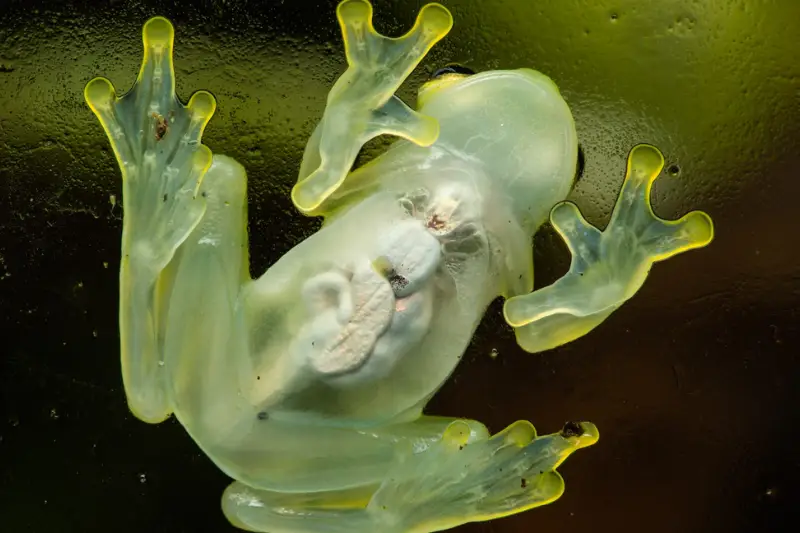
You can see the heart beating. Not suggested by the color or shape of the animal, actually visible through the skin while the frog sits on a leaf. That is what stops people when they first encounter one. And the next thought, almost always, is whether something that looks that strange is dangerous.
It is not. Glass frog facts on this point are consistent across every study done on the Centrolenidae family. The translucent belly is not a toxin warning. It has nothing to do with chemical defense. It is camouflage, and understanding how it works changes how the animal makes sense entirely.
Poison vs. Venom: Why Glass Frogs Are Not the Killers You Might Think
Two different things get confused here regularly. Venom is delivered through a bite or sting. Poison works through touch or ingestion. Frogs have no fangs, so venom is off the table. The relevant question is whether they are poisonous.
They are not. The skin secretions produced by glass frogs are basic Centrolenidae compounds, nothing with meaningful toxicity. No alkaloids. That last part matters more than it sounds. Alkaloids are the specific chemicals behind the lethality of poison dart frogs. Without them, the frog is chemically unremarkable despite looking extraordinary.
Different frog species sit at very different points on the toxicity scale. Of the roughly 7,000 known amphibian species, glass frogs occupy the harmless end. Dendrobatids, the poison dart frog group, occupy the opposite extreme. The visual difference between the two groups reflects that gap accurately.
Side by side:
- Toxicity: Dart frogs lethal through contact or ingestion. Glass frogs are harmless both ways.
- Color: Dart frogs use neon warning patterns. Glass frogs are pale, muted, see-through.
- Defense: Dart frogs use chemistry. Glass frogs use invisibility.
Glass frog characteristics build consistently toward one conclusion. Camouflage is the entire survival strategy. Chemistry plays no role.
The Art of Invisibility: Why Transparency Beats Chemical Warfare
Making toxins is expensive for a small animal. It pulls resources away from reproduction, growth, immune function. Evolution tends to favor cheaper solutions when they work. For glass frogs, the cheaper solution was structural rather than chemical.
The mechanism has a name: silhouette softening. Every solid-bodied animal resting on a leaf produces a shadow with defined edges. Predators, particularly birds, read those edges as the outline of prey. Glass frog characteristics break that system. The translucent belly lets light pass through instead of bouncing off a solid surface. The outline softens. The shadow loses its edges. From above, the frog reads as part of the leaf rather than something sitting on top of it.
Bird predators that rely on visual contrast to hunt miss glass frogs on backlit leaves at rates that would be impossible if the frogs had solid bodies. That is not incidental. It is the entire point of the adaptation.
There is a behavioral cost. Invisibility only works when the animal stays still. So glass frogs do not move during daylight. They pick a leaf above running water, position themselves, and wait. That stillness is part of the strategy, not a coincidence.
Jungle Safety 101: Identifying Dangerous Amphibians During Night Walks
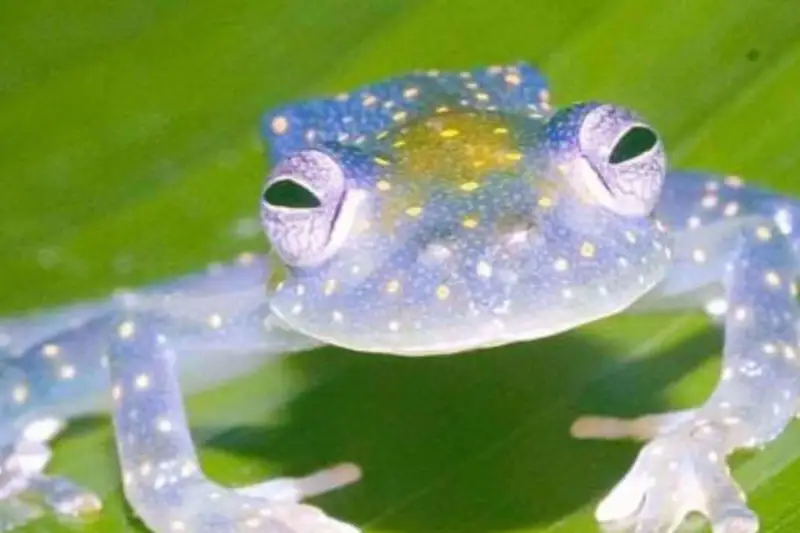
Night walks in the peruvian amazon open up species that simply cannot be found during the day. Glass frogs are one of them. Riparian zones, the wet margins along fast-moving mountain streams, are where they concentrate. After dark, on the leaves directly above the water, is where guides find them.
How is night jungle tour structured in practice? Most begin between 7:00 and 8:00 PM when nocturnal animals start moving. The route follows stream edges. Guides use headlamps for navigation and red-filtered lenses near animals to avoid disrupting behavior. A typical circuit runs two to three hours. Sighting frequency varies by season and stream health, but glass frogs appear regularly in the right zones when conditions are good.
Field identification matters because not everything on a leaf is harmless. A three-step check that works in practice:
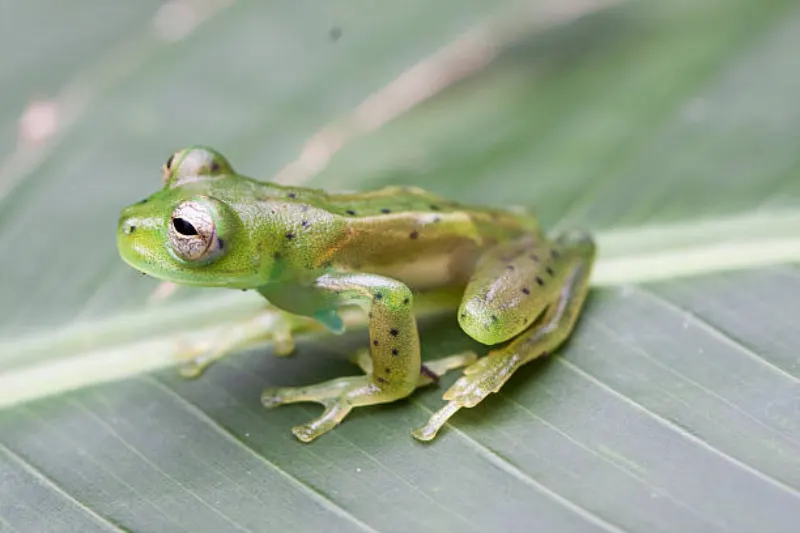
- Color: Toxic frogs use bright neon. Glass frogs are pale green and translucent with no vivid markings.
- Location: Glass frogs sit on leaves above moving water. They do not come to the forest floor.
- Behavior: Toxic frogs move openly. Glass frogs hold completely still.
Night walks in manu national park along the right stream sections produce glass frog sightings with regularity. The guides know the specific zones and leaf positions to check. Searching independently after dark without that knowledge is significantly less productive.
Handling with Care: Why Your Touch Is More Dangerous to the Frog Than Theirs Is to You
Safe for humans. Potentially harmful for the frog. That is the one-directional answer to whether touching a glass frog is acceptable.
The skin absorbs what it contacts. Skin oil, soap residue, sunscreen, insect repellent. Any of these transfer through the permeable surface directly into the animal’s system. The same tissue that produces the translucency is also what makes the frog vulnerable to external chemistry.
Osmotic balance is the specific problem. Glass frogs regulate internal moisture and salt ratios continuously through their skin. Dry human hands disrupt that process by pulling hydration out. The effect is not immediately visible but the physiological disruption is real.
Tambopata’s poison frogs make this point from the other direction. Those species are genuinely dangerous to handle and share riparian habitat with glass frogs in several locations. The external appearance of a frog does not reliably indicate skin chemistry without prior knowledge. The handling rule applies uniformly: observe without touching, regardless of which species is in front of you.
People who keep glass frogs in captivity use bioactive terrarium setups with live plants and automatic misting specifically because physical contact creates problems. Display only. No handling. That model reflects the biology accurately.
The Glass Frog’s Real Secret: Why Their Vulnerability Is Their Greatest Strength
Most dangerous animals in the Amazon survive through active offense or chemical deterrence. Size, venom, toxins, aggressive behavior. Glass frogs use none of those. The survival strategy here is subtraction. Remove yourself from the predator’s visual field and the threat disappears.
Glass frog characteristics that read as vulnerability, the transparent body, the permeable skin, the total stillness during daylight hours, are the same features the strategy depends on. The translucency is not cosmetic. It is functional. Take it away and the camouflage fails.
Night jungle is where the other half of the glass frog’s life happens. Active after dark, calling near streams, moving between leaves. The daytime stillness gives way to actual activity once the visual threat from bird predators drops. Guides who work these stream zones after dark see behavior that daylight hours never reveal.
Core glass frog facts before leaving this topic:
- No alkaloids, no meaningful skin toxins, no danger to humans from proximity or accidental contact.
- Silhouette softening on backlit leaves disrupts bird predator visual detection reliably.
- Riparian zones above fast-moving streams, active after dark, specific leaf positions above water.
- Skin permeability creates vulnerability to human contact despite being personally harmless to handle.
- Best observed on guided night walks in the peruvian amazon or manu national park during dry season months when stream levels are stable and guide access to sighting zones is reliable.
Something that transparent should not survive in a forest built around predation. The glass frog facts explain the mechanism. The animal itself demonstrates that visibility and survival are not always in conflict, sometimes the solution is making visibility irrelevant.

