The jungle going quiet after sunset is one of those assumptions that collapses immediately on arrival. Daylight hours in the Peruvian Amazon are actually the slow shift, animals tucked away from heat and predators, the canopy deceptively still. What the night wildlife emerging across the Tambopata national reserve represents is not a quieter version of the daytime forest. It is a completely separate ecosystem running on different rules.
Somewhere between 60 and 70 percent of rainforest animals are nocturnal according to tropical ecologists. That number is worth sitting with for a moment. It means the darkness is when most of the forest is actually functional, foraging, hunting, moving, communicating. Two complete biological cycles share the same physical space without significant overlap, the daytime shift handing off at dusk with a precision that looks almost organizational.
Walking into that darkness produces an instinctive discomfort that the biology quickly overrides once attention shifts from what cannot be seen to what can be heard. The night wildlife operating in this space is not navigating with less information than daylight animals. It is navigating with different information, gathered through sensory equipment that sunlight would actually impair.
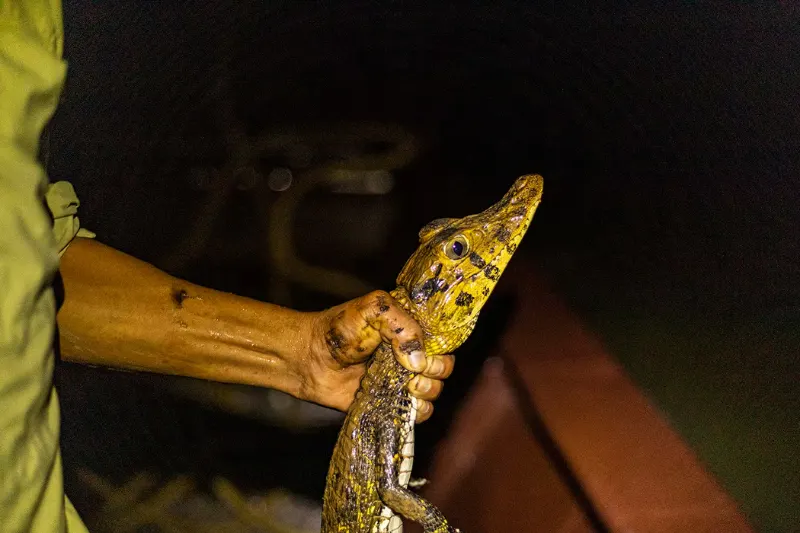
Mirror eyes and sound maps
Human eyes run on cone receptors. Those cones need bright light and produce vivid color but shut down almost completely in low light conditions. Nocturnal animals trade color vision for a density of rod receptors that extract usable detail from ambient moonlight levels that human eyes register as complete darkness. The same forest looks navigable in grayscale to an animal running on rods.
Behind those rod receptors sits the tapetum lucidum, a biological mirror that bounces incoming light back through the retina a second time. That double exposure gives the eye two chances to process the same photon, significantly amplifying low-light sensitivity. The eye-shine effect that appears when a flashlight catches an animal looking directly at it is a side effect of that mirror rather than anything the animal produces deliberately.
Some species skip light entirely and navigate through sound. Bats build three-dimensional maps from the echoes of their own high-pitched chirps, precise enough to intercept a single mosquito in dense canopy at speed. The energy cost of these adaptations is real, but the payoff covers it across three distinct biological advantages:
- Avoiding extreme heat by foraging in cool night air, preventing the dehydration that daytime activity at these temperatures would produce.
- Escaping daytime predators by moving when visually dependent hawks and eagles are roosting and effectively non-functional.
- Accessing food sources including night-blooming flowers and insect swarms that diurnal species simply never encounter.
Night monkeys and tapirs: the understory after dark
Among all the animals that live in the Amazon Rainforest, the Aotus stands out in a category of one. The night monkey is the only genuinely nocturnal primate on the planet. Every other primate species runs on daylight. The Aotus runs on darkness, with eyes taking up a disproportionate portion of its skull and functioning as dedicated night vision equipment for locating ripe fruit in complete blackness.
Locating one in the canopy requires patience and a good flashlight. They give themselves away once the specific identification features become familiar:
- Massive light-gathering eyes occupying a significant portion of the skull, built specifically for locating ripe fruit in conditions that would leave other primates effectively blind.
- Deep owl-like hooting used to communicate with family groups across the dark canopy rather than the complex chattering of diurnal primates working the same trees in daylight.
- Small agile build at barely two pounds allowing movement through branches without waking sleeping predators positioned along the same routes.
Down on the forest floor a completely different scale of nocturnal animals runs its own errands under cover of darkness. The South American tapir, a heavy mammal with a flexible trunk-like snout, travels at night to clay deposits known as salt licks. These muddy banks function as a midnight pharmacy, providing sodium and neutralizing toxins from vegetation consumed throughout the night.
Both the night monkeys working the canopy and the tapirs covering the ground perform essential ecological work while the sun is down. As these nocturnal animals move through the forest and digest their meals, they scatter seeds across distances that daytime frugivores rarely match, effectively replanting sections of forest while wandering through the dark.
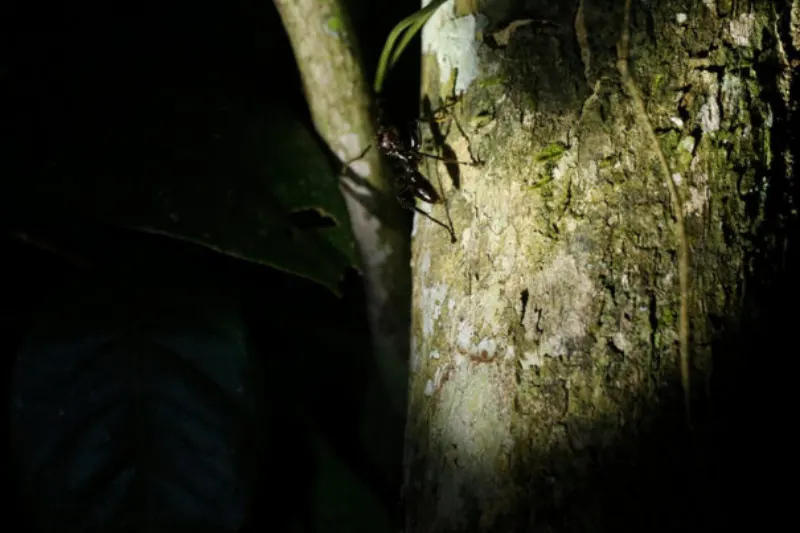
Caimans and cats: glowing eyes on the riverbank
The tributaries running through the tambopata national reserve transform after dark into hunting grounds that the daytime version of the same water does not hint at. Jaguars and ocelots work these riverbanks as crepuscular hunters, most active during the dim transitional light of dawn and dusk when long shadows create ambush opportunities that full darkness and full daylight both eliminate for different reasons.
Caimans operate on entirely different biological logic. Cold-blooded and dependent on external heat, they spend daylight hours on muddy banks absorbing solar energy and storing enough warmth in their armored bodies to keep muscles functional through the cold midnight hours. Without that daytime charging period the cool river water would render them too sluggish to strike at anything.
Caiman searching from a riverboat is one of the most accessible forms of wildlife night observation available in this region. Sweeping a flashlight along the shoreline catches the ruby-red reflection of caiman eyes sitting just above the waterline. The distance between the two glowing points tells the observer immediately how large the animal is before any other detail becomes visible. The wider the gap, the larger the caiman below the surface.
Bioluminescent fungi and insects: the chemical light show
Away from the riverbank the jungle floor produces an entirely different kind of night wildlife display. Bioluminescence is light generated through chemical reaction rather than reflected from external sources, and in the understory of the Amazon it turns the pitch-black forest floor into something resembling a scattered star map at ground level. The organisms producing it are paying a real metabolic cost to do so.
That cost only makes biological sense when the signal serves an essential function. A pulsing flash communicates reproductive availability to potential mates. A steady eerie glow signals toxicity to predators deciding whether to investigate further. The light is functional language operating in a frequency that the surrounding darkness makes impossible to ignore.
Three bioluminescent subjects dominate the dark in this part of the Amazon:
- Foxfire radiating a faint green glow from rotting logs, where fungi use light specifically to attract the insects responsible for spreading their spores through the forest.
- Click beetles flying through the canopy with two continuous glowing headlights that distinguish them clearly from the pulsing on-off rhythm of fireflies working the same airspace.
- Glow-worms sitting patiently in the soil using luminous tails as lures to draw insects close enough to strike.
Seeing any of these requires turning the flashlight completely off and waiting for eyes to adjust to undisturbed darkness. That adjustment takes considerably longer than most people expect and rewards patience in ways that keeping the light on never produces.
Mastering the night walk: gear and ethics
What is a night jungle tour in the Amazon like is a question with an answer that surprises most people who ask it. Nothing about the experience resembles a daytime hike conducted in low light. The sensory framework shifts completely, movement slows, and attention reorganizes around sound and peripheral flickers rather than direct visual scanning. Preparation determines whether that reorganization produces wonder or just confusion.
The essential gear checklist for a wildlife night in this environment:
- Red-light headlamp because red wavelengths do not contract pupils, preserving naturally adjusted night vision while still making the trail navigable between stops.
- Closed-toe boots protecting against unseen tripping hazards and soil-dwelling insects that become active on the forest floor specifically after dark.
- Insect repellent keeping the observer still and quiet by eliminating the constant involuntary movement that swatting at bites produces.
- Waterproof bag protecting electronics from the sudden rain showers that arrive in this environment without warning and without sound.
The eye-level flashlight technique involves holding the beam directly next to the temple rather than extending the arm forward. That alignment catches eye-shine reflections across a much wider field than standard handheld positioning allows. When a distant flicker appears, binoculars bring the subject into detail without requiring physical approach.
A Tour night jungle in Tambopata run by experienced local guides structures the entire experience around these principles. Groups stay small, movement stays slow, and ecological knowledge transforms the sequence of sounds and occasional eye-shine into a readable account of what the forest is doing rather than a series of unconnected encounters in the dark.
Planning a visit: when and how
Best times to visit Tambopata for night wildlife observation center on the dry season running May through October. River levels drop during these months and riverbank exposure increases, making caiman searching and boat-based observation significantly more productive than the flooded conditions of the wet season. Trail access also improves considerably, which matters for on-foot wildlife night exploration through the forest interior.
The wet season between November and April brings its own activity peaks. Amphibians and certain insects reach higher frequencies after rain during these months. But flooded trail conditions make nighttime forest walking considerably more demanding, and the logistics of moving through inundated sections after dark require experience and preparation that most visitors without prior Amazon knowledge are not equipped for independently.
Lodge-based guides with deep ecological knowledge of specific territories remain the most reliable entry point for accessing the parts of the reserve where night wildlife density is highest. That local knowledge transforms a walk in the dark from a sequence of unexplained sounds into something legible and genuinely extraordinary.
Light pollution and protecting the Amazon’s nightscapes
Darkness is not an empty space. It is active habitat for the majority of rainforest species, and artificial light disrupts that habitat in ways that accumulate across seasons and generations without producing obvious immediate consequences. The broken compass effect describes what happens when artificial light sources scramble the internal navigation systems of nocturnal animals that depend on darkness, moonlight, and starlight to orient themselves across the forest.
Reducing that disruption does not require dramatic action. Turning off unnecessary outdoor fixtures before bed produces immediate local results. Replacing remaining security bulbs with warm-toned LEDs and adding motion sensors reduces light duration and intensity without eliminating security function. Small changes in illumination habits produce real consequences for the animals navigating in the darkness just outside.
Understanding what a wildlife night actually contains changes the relationship with darkness in ways that conservation messaging alone rarely achieves. Every unnecessary light that gets turned off gives the nocturnal animals in that territory access to the navigational system that millions of years of evolution calibrated for exactly these conditions. That is a concrete and direct result from a genuinely simple action.

