With a name like “cock-of-the-rock,” you expect a bird with an attitude and you wouldn’t be wrong. Famed for its neon-orange plumage and a punk-rock crest that seems too perfect to be real, this South American native is one of the most eye-catching birds in the world. That bizarre crest, a permanent half-disc of feathers so large it often hides the beak, isn’t just for show. It’s central to a strange social life where dozens of males gather for intense, competitive dance-offs.
From the secrets of its name to its unique courtship rituals, these 10 fascinating facts reveal what makes the cock-of-the-rock truly one of a kind.
Fact 1: Their Crest Isn’t Just Feathers
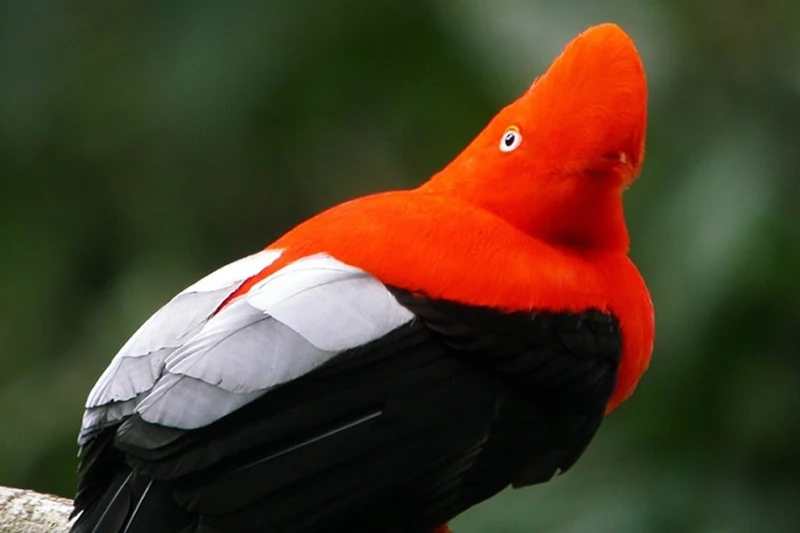
The pretty half-circle upon the head of the cock-of-the-rock may seem like a plank of solid helmet, though it is a delicate crest of feathers. The crests of most birds spread back, but in the male cock-of-the-rock there are two sets of feathers which up and forward converge in the middle. This permanent hairstyle is so exaggerated that when viewed at a side. The hairstyle involves the beak of the bird being totally covered.
It is not just a gimmick headgear: it is a serious instrument of courtship. To a male, a massive and absolutely symmetrical crest. The ultimate status symbol that female can see him as a strong healthy potential mate. When they are competing to mate with a female. The males bob and move in order to make their crests visible in all angles because a perfect crest may be the difference.
Fact 2: Why the Cock-of-the-Rock Shines With Splendid Colour
That orange is not merely an accident of heredity, it is a necklace to be put on. The question as to why the cock-of-the-rock is so gaily orange is answered by its feeding. The bird acquires its color depending on the natural pigments in the fruits that it feeds on. The richer the fruit that a male is, the more his feathers will be colored. A brilliant partner to a female is a healthy one. Which has shown that he is a master at getting the best food. This is what makes him one of the most well known colorful birds of the Andean exotic wildlife.
Naturally, it has a perilous negative side to it being so beautiful. Where his color is a hypnotizing factor on female, it is like a neon marker to predators such as the hawks and eagles. Being a male cock-of-the-rock is a game of high stakes where one has to perform a balancing act all the time.
Fact 3: Why the Female is the Total opposite of the Flashy Male
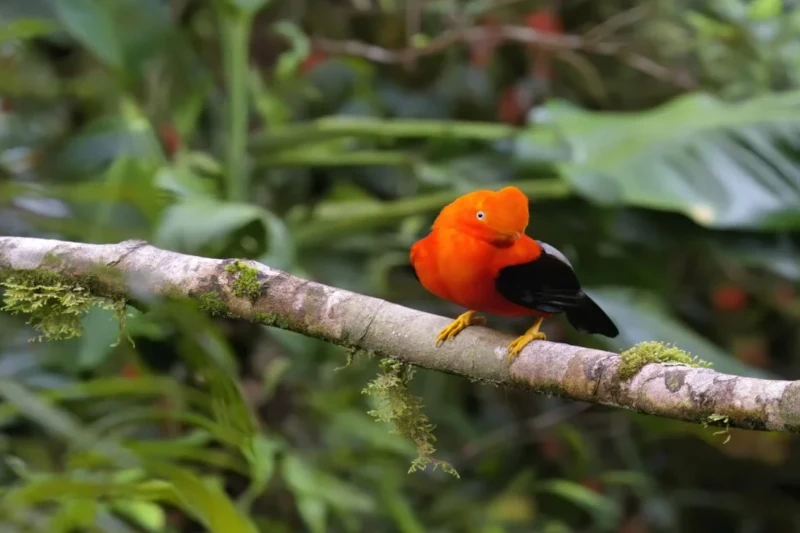
Whereas the male cock-of-the-rock resembles the splash of neon orange. His female counterpart is the absolute opposite of that. She is a toned down, brownish-grey bird that fades into shadows of the forest floor and the rocks cliffs. This fantastic disguise does not mean that she is insignificant the disguise is her best weapon of survival. Her dull color enables her to sit on her nest and hatch her chicks without being detected by predators. Which gives her young the best opportunity in life.
This conspicuous difference of phenotype between males and females. One species is a widespread mechanism in the animal kingdom, and it has a technical name; sexual dimorphism. It only implies that the two sexes have different forms or appearance. In the case of the cock-of-the-rock, there can be no more acute difference or more at stake. Finally, their physical appearances are just right to their roles. The whole idea of the male is to look as visible and spectacular as possible to find a mate. The female is expected to be invisible as this is the way to ensure the survival of the next generation.
Fact 4: They Don’t Sing to a Mate – They Have Sensational Group Dance-offs.
Rather than having the traditional image of a male bird singing a tender ballad over a female to lure her/him, the cock-of-the-rock uses a much more dramatic method. Imagine that it is not a personal serenade and make it a competition-style audition. Several groups of ingenious orange males meet in a particular part of the forest, not to collaborate but to directly rival to get the interest of the coming females.
This is a classic meeting place referred to as a lek. In this environment of nature, every male carves out a small space of land, his own stage and starts acting. The cock-of-the-rock courtship dance is an odd and curious affair, to which deep bows, wild wing flutings, head bobbing, and a peculiar involuntary succession of squawks and clicks are added. It is a riot of color and noise of bright colors, as each of the birds attempts to show off to his competitors.
As the males are performing the female spectators watch them keenly through close-by branches, just like judges in a talent contest. They are watching the participants, evaluating their strength and the level of their performance. Once a female has reached her decision and copulates with the fanciest male, his task is accomplished.
Fact 5: The Males are All Shows- Females are the Sole Mothers of Bird World.
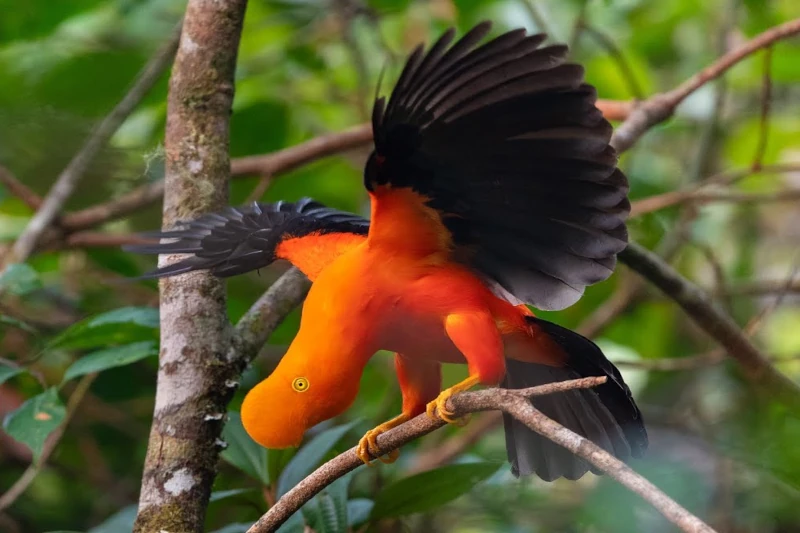
And that grand dance at the lek is all the parloring of male kind. After a female selects him and they copulate he is totally finished. He assists not in the construction of the nest and incubation of the eggs, or feeding the young. His whole life plan is to be the most prestigious performer in the lek enabling him to transfer his genes before coming back to the competitive show. This show, no-through strategy places the female with one of the most difficult jobs in the jungle fully on her own.
Consequently, the female cock-of-the-rock is the single mother of all times. Only she decides where to build a nest and chose a safe place, forms the nest, spends almost a month on incubating her eggs and endlessly seeks food to feed her babies. It is her plain, almost brownish coloration which is a saving grace in this dangerous season and is the ultimate camouflage to avoid predation. The task of the man is to be visible, hers to be lost in the woods.
Fact 6: They Are Master Masons, Building Nests from Mud and Saliva
The female cock-of-the-rock, being without a mate to assist her in the defence of her nest, has no other choice but to be very tactical with regard to the nest. The commonplace assortment of twigs and leaves is to be forgotten; she is a bird-mason herself. She collects mud with her beak and combines it with her own saliva in order to make a cement-like paste. After that she carefully shapes this substance into a cup-shaped but heavy object which may weigh more than 20 pounds (9 kg) after drying.
This peculiarity of construction becomes necessary due to the location on which she constructs it. The female binds her mud nest of bricks in a very substantial form, to the lee of sheltered, vertical rock faces, or within the entrance of a cave, or on the side of shady ravines. This intelligent location places her vulnerable eggs and chicks far away out of reach of most of the ground-based and tree-climbing predators. This is a brilliant defensive strategy which keeps her family safe not only that but that is how the bird got its strange name.
Fact 7: The Secret of their Cock-of-the-Rock Name
The weird name of the bird is marvellously literal in presenting the manner of its life. The -of-the-rock half-line means that it favors the construction of its heavy mud nests on bare rock surfaces. The employment of rocky clearings, or leks, in its courtship displays. They are masters of a stoic kingdom indeed.
The initial section of the name is equally clear. Cock is an ancient ancient name of any male bird, most popularly a rooster. Combine it all and you end up having a name that perfectly describes a picture, the startling male bird of the rocks.
Fact 8: They Are the Unrecognized Gardeners of the Amazon
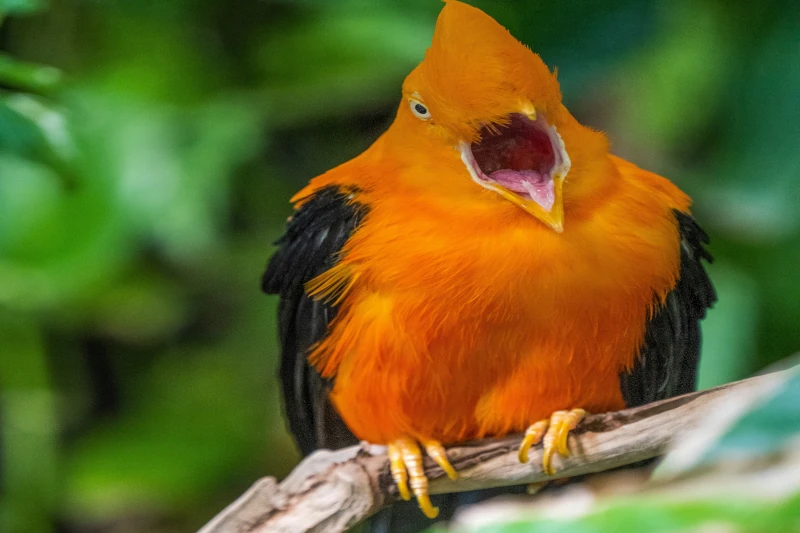
The colour of that wonderful orange has to be made somewhere, and in the case of the cock-of-the-rock the clue to it all lies in his diet. These are nearly purely fruit-eaters, in which fruit composes more than 90 per cent. of their diet. This is a specialized diet that makes them the scientific nomenclature of frugivore (literally, a feeder on fruits). They do not have their way, but like fruits of the laurel and nutmeg families, they swallow whole.
Their role in the Amazon rainforest therefore makes them important, albeit by chance, gardeners, by virtue of their heavy-fruiting way of life. Upon swallowing the pulp of a piece of fruit, the bird flies away and later regurgitates the seed in another place, with a small portion of fertilizer in it. Seed dispersal is critical in the process of regenerating the forest. Although fruit is their main staple, they are not strict vegetarians. In order to obtain some protein, particularly when hungry chicks are to be fed. They will sometimes take large insects, small frogs, and even lizards.
Fact 9: They Call Like a Frog Not a Bird.
As a creature is so much like a piece of art, one might want to hear a beautiful and melodious song. What is really the case is even more bizarre. The cock-of-the-rock is capable of causing alarming varieties of non-musical noises instead of the dainty twitters of a songbird. Its sounds are an inexpressible combination of guttural squawks, loud popping sounds, and groans that remind more of the frog or a pig than that of a prize-winning bird. There is even a sharp cracking sound made by the males (snapping of beaks).
These strange tones are not something without sense; they are an important component of the performance of the male. These squawks and pops are used to frighten off the competition and seize the attention of the choosy females during the mad, cap competition at the lek. Another and more pointed call serves the purpose of a sharp alarm to alert the whole group of an incoming predator. This confirms that a voice does not necessarily need to be beautiful to be useful in the rainforest.
Fact 10: It is a National Pride Symbol of one Species.
The star status of this bird stretches way out of the forest canopy. Rupicola peruvianus in Peru is an impressive cock-of-the-rock that is made the national bird. It has now turned into a colorful icon of the amazing biodiversity of the country. Where nature enthusiasts on Peru jungle tours would visit the preserved zones such as the Madre de Dios to be given an opportunity to see its flaming plumage. To Peruvians, the bird is something that they can be proud of as it is a symbol of the wild and untamed beauty of the Andes.
But how do you distinguish this national icon of the cock of the-rock (Rupicola rupicola) of equal fame with its equally famous cousin, the Guianan cock-of-the-rock (Rupicola rupicola)? The point is in the contrast of colors. The Guianan, being an orange-colored animal, is uniform, flaming oranges. The Andean one is a deep scarlet-red animal on jet-black wings and tail. It is a slight, though prominent, distinction, between the two most spectacular birds in the continent.
How You Can See This Dazzling Bird
The story behind that flash of orange is now clear: the high-stakes drama of the lek dance-off, the architectural genius of a mud-and-saliva nest, and the stark contrast between the flamboyant male and the resourceful single mother. The cock-of-the-rock has transformed from a strange name into a symbol of the wild, complex life hidden within the cloud forest canopy.
This spectacle isn’t just for documentaries. If this new knowledge has sparked your curiosity, you can start by exploring responsible birdwatching tips online. The best places to see the cock-of-the-rock are at lodges near their famous lekking sites. Top locations for these jungle tours include:
When you research, prioritize operators that hire local guides. This ensures your potential visit directly supports the communities that are the frontline stewards of these habitats.
While the cock-of-the-rock’s conservation status is currently of ‘Least Concern.’ Its survival is entirely tied to the health of its home. The bird is an ambassador for the entire cloud forest ecosystem. By appreciating this single, dazzling species, you’ve taken the first step toward understanding. The irreplaceable world it represents a world that depends on our awareness and protection.

